6 Tips for Players Who Don't Think They Can Be Game Masters
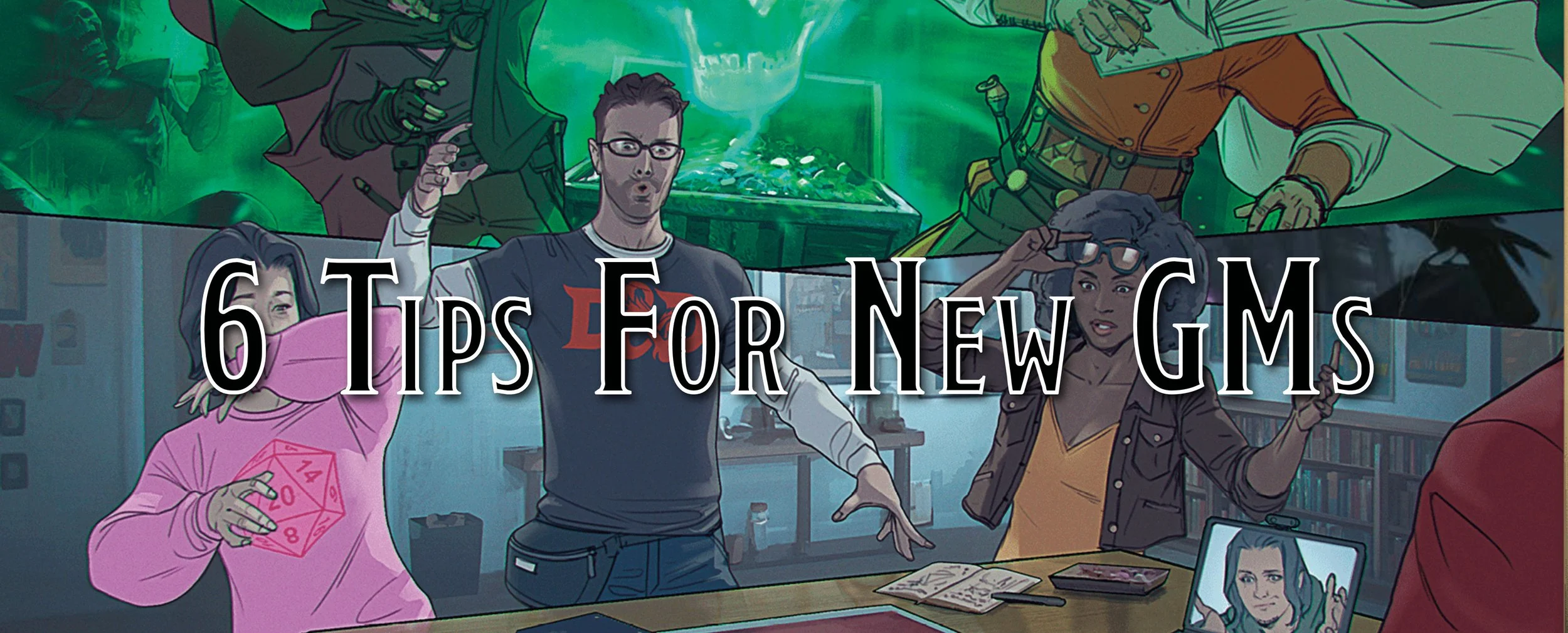
Whenever we are at conventions, I talk to a lot of players who swear they could never be Game Masters. They worry they’ll never be good enough or that they don’t know all the rules or worry about being fun enough. In my opinion, every one should try their hand at Game Mastering a few sessions as it opens up a new understanding of the game, and lets you appreciate even more the talents and work that goes into a campaign.
If you’re worried about GMing, here are 5 tips to help ease your mind and get you through your first game!
1) You Don’t Need To Know All The Rules
No one knows all the rules. I’ve been playing (mostly as a Game Master) for about a decade, and I even produce and create content for D&D, but I don’t know all the rules.
There is no requirement for you to know all the rules for whatever game system you are running. Even those one-page systems, like Honey Heist, you aren’t going to know all their rules because things fly out of your head.
All you need to know are the basic mechanics of the game. For Dungeons & Dragons, that means you just need to remember that players roll D20 Tests to overcome obstacles. A D20 Test requires rolling a d20, adding appropriate modifiers to the roll, and then comparing it to a set Difficulty Class (DC). This includes Attack Rolls, Ability Checks, and Saving Throws. If you know that basic mechanic, you can run 99% of D&D with little trouble.
When you need to know a certain rule, you can just look it up or make it up. I never remember how high players can High Jump (cause it doesn’t show up very often). If there will be little to no impact on the game, it’s fine to just make a note and look up the rule after the game. If it has a greater impact on the game, you can look it up (or ask another player to look it up while you keep the game moving forward).
If you do change how you want to make future rulings, make sure you announce that to the whole table and communicate this change.
2) Talk To Your Players
Everyone runs into issues. They might be as small as a stirge or as large as a tarrasque, but they’re going to happen. When you run into trouble or have a difficult time with the antics or actions of the other players, you need to remember to communicate.
Talk with the group or individual players outside of the game and share your experiences. Don’t lay blame or accuse players, just explain the situation and how it is affecting you or the game.
Almost any problem can be solved by simply talking with the other players, either one-on-one or as a group. It can be intimidating to do so, but by having clear communications and expectations of everyone in the game, you’ll have a far more enjoyable experience and be excited to GM for your table.
3) Yes, And / No, But
There is a ton of advice about how GMs need to know how to ‘Yes, And’ their players. If you don’t know what that means, it is a way for improvisers to accept what others have said (Yes) and then expand on that concept (And). It is a rule that states you shouldn’t reject the ideas of others. However, that is only a single tool and works best in freeform thought experiments where you don’t have rules to help guide play.
GMs should also freely use ‘No, But’ in equal measure. This allows you to refine another player’s ideas and challenge them in a constructive manner. Often, this can be done when a player wants to do something, like convince a dragon to give up all its treasure without a fight. While you don’t want to reject their idea outright, it would not be a fun game for the player to just get all the treasure without going on an adventure (they are adventurers, after all). Instead, you could ‘No, But’ the idea by saying the dragon won’t give up its treasure (No), but will pay the party if they go on a quest for it (But).
4) It’s About Having Fun
This game is about having fun. You, the Game Master, are supposed to have fun, just as much as the other players are supposed to have fun (as a reminder, the GM is also a player; they just have a different role). Don’t let their fun overshadow your fun, and don’t let what you think to be fun overshadow the other player’s fun.
This is a collaborative game and works best when everyone is working towards the most fun for all people (not just most people).
5) Don’t Be Reactive
Sometimes, the luck of the dice can create a shocking moment that destroys an encounter in a single action. In these situations, you might have a strong reaction, but try not to act on those. If a character clears an encounter easily, that’s OK, they got a chance to shine, and you should celebrate their win.
Don’t try to nerf their accomplishment, like changing the rules or forcing them to change their class or class abilities. In all likelihood, it was just a misunderstanding of the rules or the lucky roll of a series of dice. Between sessions, take a moment to review the rules that led to the event, and then figure out if there was something missed or played wrong. At the start of the next session, announce anything new you learned and, without taking away their accomplishment, say that going forward, the table will follow the official rulings.
If you did everything by the book, it might be tempting to nerf players, but we strongly discourage you from doing that. The rules are written for a reason, and while something might feel strong now, it won’t feel strong in the future when the other players gain new abilities and powerful spells.
The simplest way to ‘adjust’ the difficulty of your encounters is to remember to include more than one or two encounters in an adventuring day. By forcing players to be thoughtful about how they use their abilities, they won’t have the opportunity to go all out in a single combat round.
6) You Don’t Need To Be Original
First things first, there is nothing original under the sun. Thinking you have to create a whole world for your party to adventure in is wrong. While you can do that, you don’t have to unless you derive enjoyment from worldbuilding. If that isn’t your fun, then use a pre-made world. And if you don’t know all the lore, that’s OK! You can make it up as you go, change things as you see fit, and you can always learn more about the world later on if you care to.
And this isn’t even tied to just worldbuilding. I’ve heard plenty of people say they don’t know how to create a campaign or build an adventure, and you don’t need to know that. You can run pre-written campaigns and adventures, and still have a great time! Players don’t care if a campaign is made up on the spot or pre-written; they’re just excited to roll shiny math rocks and use silly voices.
Other Advice?
Do you have advice for first-time Game Masters? Especially for players who think they can’t hack it? Share it in the comments below!
Like what we do?
Join our Patreon!
You’ll get early access to deep dives, the Homebrew Hoard
featuring 500+ monsters, ad-free articles, and more!
Follow us on Reddit to keep up to date on everything we talk about!