Deep Dive - The Stirge
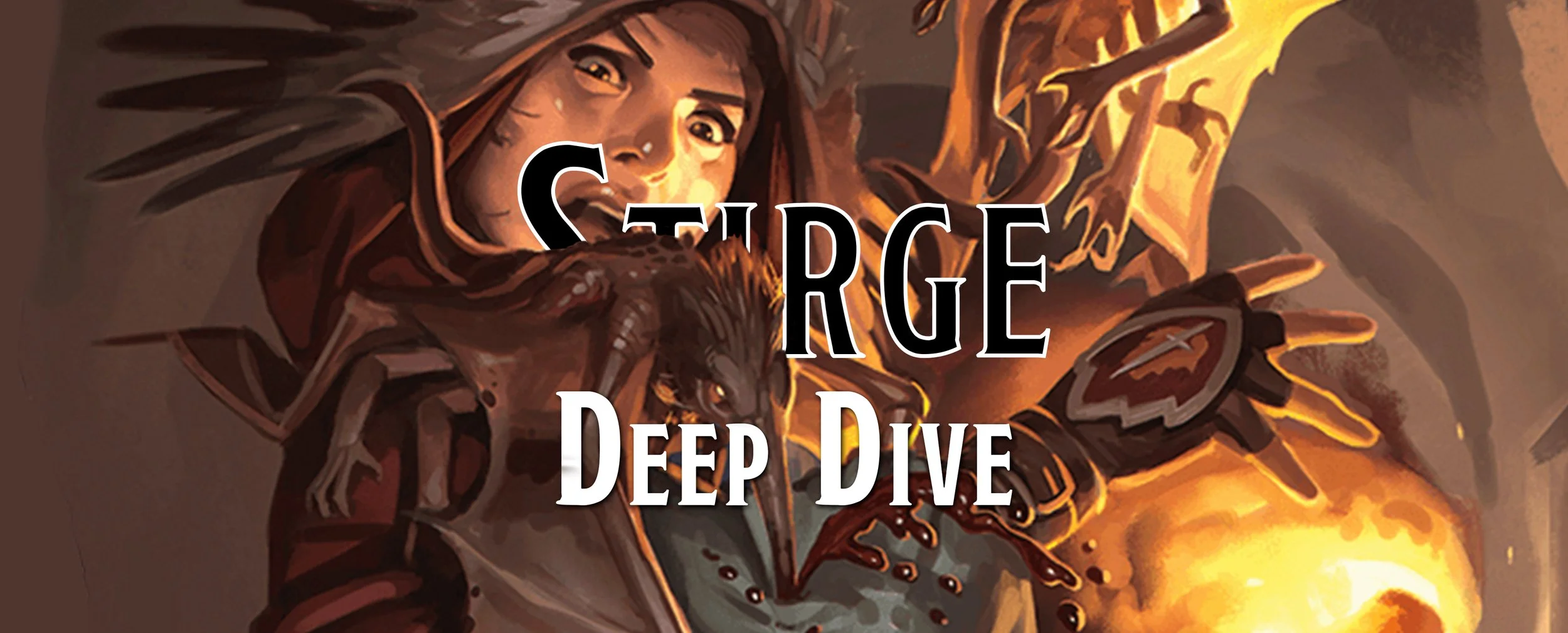
This bloodsucking parasite isn’t a vampire, or your ex, but rather a normal beast that low-level adventurers are often dealing with, especially in caverns, forests, or wherever warm-blooded creatures like to gather. They typically attack in swarms and can drain an adventurer dry in a matter of minutes. While they are considered more of a dangerous nuisance, maybe there is more to these mammal mosquitoes than meets the eye… or they’re just a nuisance that should be killed with extreme prejudice.
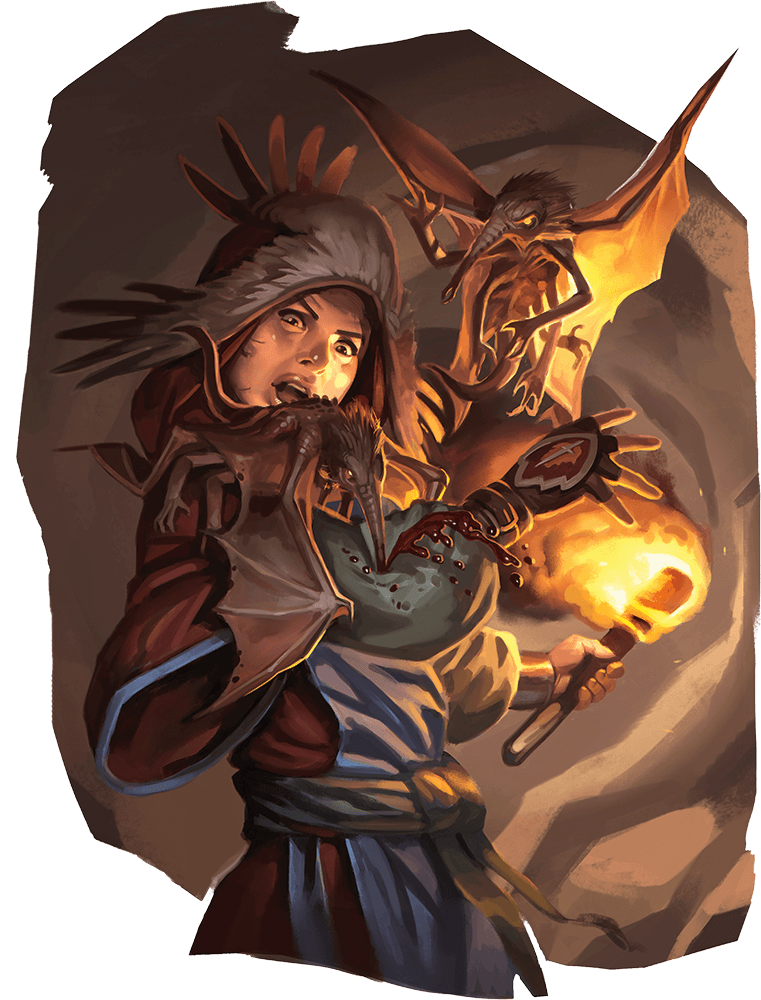
Tales from the Yawning Portal, 2017 Wizards of the Coast
OD&D - Stirge
No. Appearing: 3-30
Armor Class: 7
Move: 18”
Hit Dice: 1
% in Lair: 55%
Type or Amount of Trasure: D
No. of Attacks: 1 bite
Damage/Attack: 1-3 plus drains blood
The Stirge makes its debut in Supplement 1: Greyhawk (1975) and appears alongside the giant tick, giving the vibe they are distant cousins who see each other only at Thanksgiving. They are described as large, bird-like monsters with long proboscises. Some people even reckon that they look like small, evil-looking, feathered anteaters, which is a wild comparison but really paints the picture in your mind. Your blood’s the ant, and the Stirge is hungry.
Now, you’re probably wondering how to avoid becoming a large coke for a Stirge’s straw-nose. Stirges are attracted to warm-blooded creatures—so if you’re playing a lizardfolk, you’re safe. If they sense a likely meal, it first attaches itself to its prey, dealing 1-3 damage. You now have a single turn to try and pry it off before it starts slurping you like a tall glass of iced tea. If you don’t pry it off, it begins draining your blood, which deals 1-4 points per round until you become a bloodless corpse.
After the Stirge feeds by literally sucking all of the blood from your body like you’re a giant cherry slurpee, the Stirge becomes bloated and moves out of the field of battle to digest its delightful liquid meal. Which is lucky for your companions, they won’t have to deal with the fearsome Stirge that slayed you. May they remember you fondly.
Of course, a single Stirge isn’t that dangerous. It only has a single hit die, so up to 6 hit points, meaning you could just step on them and kill them. They’re squishy, just like the d4 hit point wizard of this edition. But where you would probably only run into having to fight a single wizard, you could be fighting up to 30 Stirges at a single time. This could easily be enough to drain an entire adventuring party, so you'd better hope that you have a big area of effect spell… like fireball!
AD&D 1e - Stirge
Frequency: Uncommon
No. Appearing: 3-30
Armor Class: 8
Move: 3"/ 18"
Hit Dice: 1 + 1
% in Lair: 60%
Treasure Type: D
No. of Attacks: 1
Damage/Attack: 1-3
Special Attacks: Drain blood
Special Defenses: Nil
Magic Resistance: Standard
Intelligence: Animal
Alignment: Neutral
Size: S
Psionic Ability: Nil
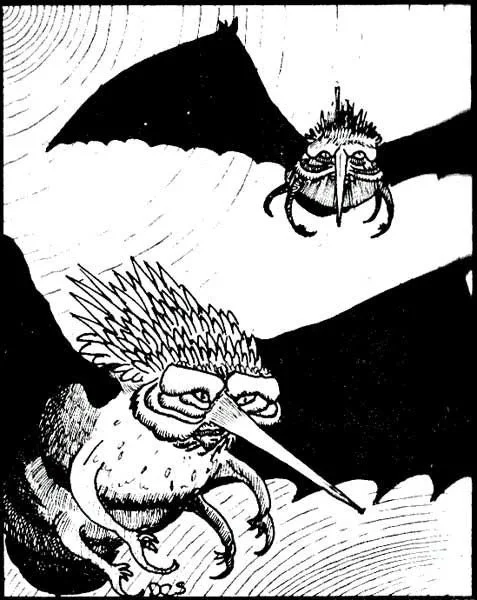
Monster Manual, 1977 TSR Inc / David C Sutherland III
The Stirge makes its glorious return in Monster Manual (1977) and even comes with a depiction of this flying anteater. Well, it doesn't really look like that anymore, but rather it does look like a very drunk and very tired bat with a sharp nose and way too many limbs. To go along with their image, we get a new description that describes their feathers as rusty red to red brown with yellow eyes and feet, and their proboscis is pink at the tip but gray at the base. Don't know what a proboscis is? The dictionary defines it as an elongated sucking mouthpart that is typically tubular and flexible. In other words, it's the facial straw through which all your blood is sucked from your body.
Not only do we get an updated description, but we also receive updated information on their hunting habits, how they hunt, and the likelihood of them not killing you if only one of them attaches to you. If you want to avoid them, avoid dark forests and subterranean lairs. If you don't want to get eaten, but still want a nice dark stroll through a forest or tunnel, don't be a warm-blooded creature. If you still go against our advice and choose to be warm-blooded, then try not to stumble across up to 30 of these creatures at the same time.
If you do find a nest of these creatures, they attack by attaching themselves to you and shoving their proboscis into your supple flesh, dealing 1-3 damage. After that, every round, it drains between 1-4 hit points of damage in blood. Luckily, you don't have to worry about it killing you, as it will automatically stop after it has drained 12 hit points. Of course, if you have fewer hit points than that, then you should still be very concerned about it killing you.
Once it has drained 12 hit points, it detaches and then flies off to digest its delectable, bloody treat. But, let's say you want to stop it from taking your blood, since you still need it to feed the vampires you're off to fight, how do you remove it? Well, you don't. At least, you don't rip it off unless you kill the Stirge first. If you can't manage that, then you'd better hope you have more than 12 hit points when it slakes its thirst.
The question of whether or not the Stirge is a bug or a bird is answered in The Ecology of the Stirge, written by Ed Greenwood in Dragon #83 (March 1984). The answer? More like a bird, but also, it's a mammal, so maybe not like a bird at all. We hope that was helpful, cause we're still confused.
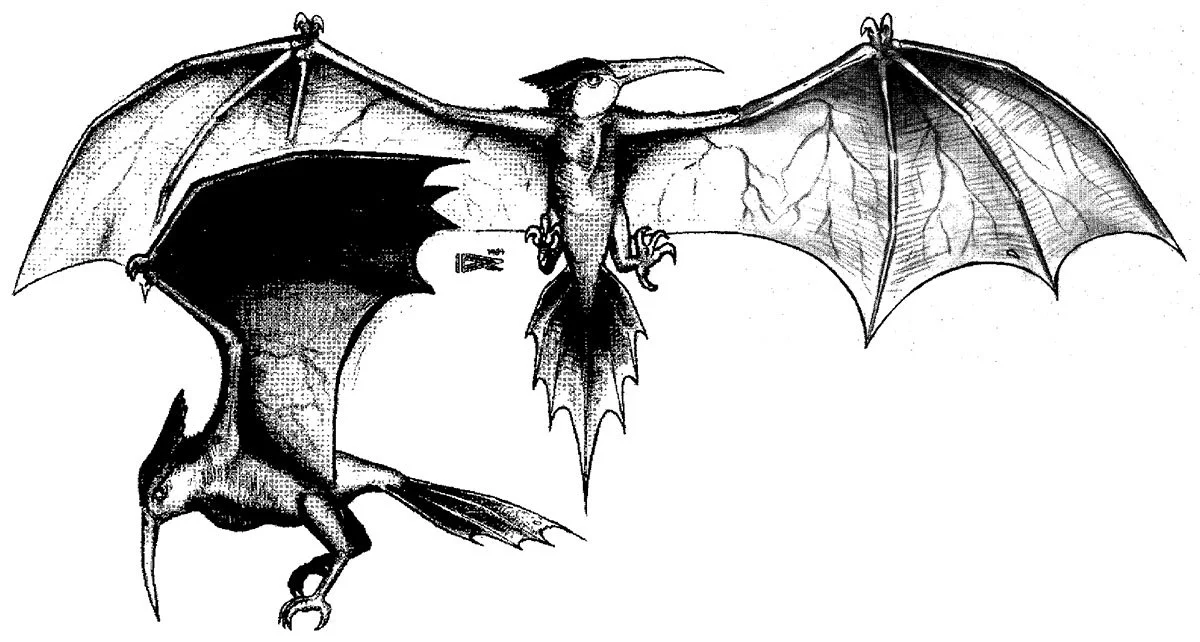
Dragon #83, March 1984 TSR Inc / Roger Raupp
But let's shove our proboscis into this article, as it comes full of blood… err, information. Remember that definition of the proboscis? Well, the Stirge's proboscis is described as a hollow, needle-beak that is several inches long. Their bodies are 1 foot long from beak to tail, and they have a 3-foot wingspan. Their proboscis is so sharp that goblins often use them as daggers, especially when they fill the proboscis with poison.
Now, let's get into the mammal-like qualities of this blood-sucking bat. When Stirges are feeling naughty and want to further their terrible species, they find a mate and six months later, the mother will give birth to one to three Stirglings. Now, most mothers are pretty loving of their young, even when they accidentally have triplets. Not so for a Stirge mother who has a stern limit on how much love they have in their blood-sucking bodies.
If they have three Stirglings, they only care about two of them. The first two to cling to the mother's back are kept; the third is tossed aside to either fend for itself or simply die. It's probably going to die as no other Stirge is willing to help out a third Stirgling and refuse to give piggy-back rides to the soon-to-be-dead orphan.
These young Stirglings cling to their mother's back for up to four months, sucking blood out of any creatures the mother clings to and feeds on. Once the four months are up, they are too big for their mother to carry them, and they must fend for themselves. After another 3 months, they are full-grown, and it's time for them to figure out how to be an adult, pay taxes, and hunt on their own.
The text goes on to explain various other aspects of Stirges, including their immunity to diseases they absorb from the blood of infected creatures. They can, however, pass these diseases on to their next victim. Additionally, they are largely unaffected by poisons that harm humans and the beasts from which they drink blood. That they can subsist on a full stomach of blood for three days, and that if they go four days without drinking blood, they'll die.
Lastly, if you're a kind Game Master, the article informs you that only about six Stirges can fit on a single Medium-sized creature, like a foolish elf or human going on adventures. It also tells you that if you are a cruel Game Master, have the Stirges land on the victim's back because then the victim can't attack them and must rely on their allies to kill the Stirge for them. Of course, if their ally misses the Stirge, the victim should take the damage instead.
Basic D&D - Stirge
Move: 180 feet/turn
Hit Dice: 1
Armor Class: 7
Treasure Type: Q
Alignment: neutral
Attacks: 1
Damage: 1-3 hit points
The Stirge swoops in for your blood in the Holmes Basic Set (1977), Moldvay Basic Rules (1981), and Mentzer Set 1: Basic Rules (1983). Only basic information is provided in each of these books. From being described as a large bird to a feathery anteater, it’s a lot of the same information we’ve learned.
The only bit of new information we get is that Stirges get a +2 bonus on their first Hit Roll against a victim, thanks to their speedy dive attack. So, keep your fighter covered in plate armor at the front of your group and try to look as sickly as possible, with the worst-tasting blood.
AD&D 2e - Stirge
Climate/Terrain: Forests or subterranean
Frequency: Uncommon
Organization: Clusters
Activity Cycle: Night
Diet: Blood
Intelligence: Animal (1)
Treasure: D
Alignment: Nil
No. Appearing: 3-30
Armor Class: 8
Movement: 3, Fl 18 (C)
Hit Dice: 1+1
THAC0: 17
No. of Attacks: 1
Damage/Attack: 1-3
Special Attacks: Blood drain
Special Defenses: Nil
Magic Resistance: Nil
Size: S (2’ wingspan)
Morale: Average (8)
XP Value: 175
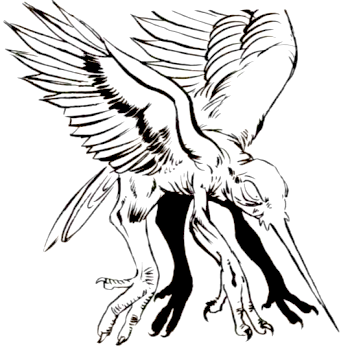
Monstrous Compendium Volume 2, 1989 TSR Inc / Jim Holloway
Forced to wait until the Monstrous Compendium Volume 2 (1989) before being reprinted in Monstrous Manual (1993), the Stirge is back with an all-new image, and it is as horrific as anything else we’ve seen. It has feathered wings, a long, needle-beak, and four grotesque legs with bird-like talons on each leg. Their legs are so awful that they are described as pincer-like, and we can’t help but shudder in our plate armor when looking at them.
Much of their mechanics remain the same, so instead let’s look at the fun stuff, like how they now make nests in attics. Now you’re no longer even safe in your own home. In addition, despite how bird-like they might look, they hang upside down like bats, so now you can’t even tell if the bat in your attic attacking you is a bat infected with rabies or a bloodsucking vampire.
Speaking of bloodsucking vampires, Stirges can be bred in captivity, and do you know who likes to do that? You got it, vampires! They need a steady supply of blood, and since vampires are already out on the town looking for blood, it must not be too much of a problem to grab an extra bloodbag or two from their bed at night.
But what about Stirges who aren’t living the high life with freshly caught children to feast upon? Well, they hunt with infravision and have an incredible sense of smell. After a successful hunt, where you get all your blood drained, a Stirge returns to its nest and then passes out for 12 hours while it digests your lifeforce and prepares itself for another round of drinks.
Druids and rangers are quite adept at spotting when colonies of Stirge arrive in the area, in part due to the large number of saguinated animal corpses. Since Stirges typically hunt within a mile of their home, they often move their nests to find fresh blood and are hard to track down when on the move.
Many people think of Stirges like dangerous bats, so it may not surprise you that there are rumors of especially large Stirges in the deepest tropical jungles. They are said to mingle with giant vampire bats, and by mingle, we mean they engage in hot, sweaty sex. The alleged result? A flying horror the size of a Mini Cooper. And its proboscis doesn't just siphon blood; it injects a paralytic agent first. So you get to lie there, fully conscious and aware, as it empties you like a juice box. A delightful, efficient feature, really. Fortunately, these are just rumors, and no living specimens have been found, so stay away from jungles and you’ll be safe from giant-sized Stirges.
You know what variant of Stirges aren’t myths? Canyon Stirges are found in the adventure Storm Riders (1990), which are smaller variants of Stirges who are more agile and considered even more vicious. This viciousness stems from the fact that they drain blood twice as fast as their larger cousins and strike only in swarms, with four of them attacking the same victim at a time.
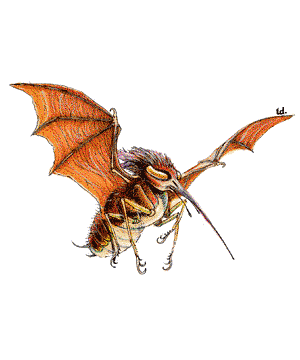
Monstrous Manual, 1993 TSR Inc / Tony DiTerlizzi
After them are the Stelurge Stirges found in the article Three Wizards Too Many by Ed Greenwood in Dragon #196 (Aug 1993), which are identical to Stirges except they have greater strength, larger stomachs, and bone-barb tails that they use to stab their prey while chowing down. They are only satiated with blood after they’ve drained 20 hit points and are smart enough to know to detach when threatened with death… only to later swoop back in and drain more blood when their victim is distracted.
Our last bit of Stirge facts comes with two new Stirges in a second, The Ecology of the Stirge, this one written by Tim Richardson, in Dragon #239 (Sept 1997). We aren’t sure why the Stirge gets to be one of six creatures in Dragon’s history with two Ecology of articles when the werewolf didn’t even get one. This article provides a story about how dangerous Stirges are, as well as two new Stirges to unleash on your enemies (that’s what we call players at our table).
The new Stirges are the Desert Stirge and the Jungle Stirge. Desert Stirges appear more like large, feathered mosquitoes with short, stubby wings that are incapable of flight. They burrow beneath the sand during the day and typically hunt at night when their prey is about. They rarely go after humans, but when they do, they detach after they drain 8 hit points and bury themselves deep in the sand to sleep off their meal.
Jungle Stirges are twice the size of a normal Stirge, and it seems like they may not be a myth like we had hoped. They have tiny wings, but can fly for about a round, and ooze poison from their proboscis. If you get hit by one, you must save against poison every round it is on you, or you become paralyzed for 2 to 12 hours, plenty of time for the Jungle Stirge and its flock of 20 to feed on you.
Of all the Stirges, Jungle Stirges actually like treasure, shiny things like jewels or coins, so if you have the chance, keep an eye out for their nests. Of course, they aren’t easy to find, and you’ll probably have other things to worry about, like all of your blood flying away into the jungle.
3e - Stirge
Tiny Beast
Hit Dice: 1d10 (5 hp)
Initiative: +4 (Dex)
Speed: 10 ft., fly 40 ft. (average)
AC: 16 (+2 size, +4 Dex)
Attacks: Touch +6
Damage: Touch 1d3-4
Face/Reach: 2 1/2 ft. by 2 1/2 ft./0 ft.
Special Attack: Attach, blood drain
Saves: Fort +2, Ref +6, Will +1
Abilities: Str 3, Dex 19, Con 10, Int 1, Wis 12, Cha 6
Skills: Hide +14
Feats: Weapon Finesse (touch)
Climate/Terrain: Temperate and warm forest and underground
Organization: Clutch (2-4), swarm (5-8), or flock (9-13)
Challenge Rating: 1/2
Treasure: None
Alignment: Always neutral
Advancement: —
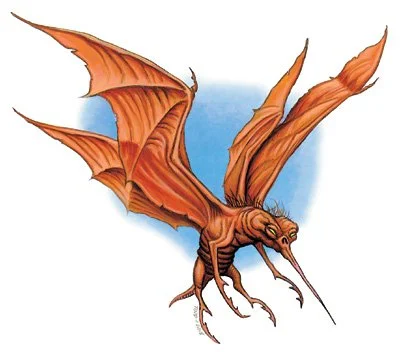
Monster Manual, 2000 Wizards of the Coast / Todd Lockwood
The Stirge is back and ready for blood in Monster Manual (2000/2003). They get a redesign, and part of us think it is for the better, even if the new design gives us the heebie-jeebies. They are described as a cross between a bat and a giant mosquito with membranous bat wings. Its body is short and furry, but the artwork makes it look almost hairless, like a sphinx cat, and they have eight jointed legs that end in sharp pincers with a needlelike proboscis. They are typically reddish-brown and have a dirty yellow underside. Lastly, their artwork depicts them with four wings, so that’s very insect-like, and we don’t like that at all.
So it’s an all-new edition with all-new mechanics. Does anything change for our delightful bloodscourge? They still have to make an attack when trying to attach and stick their proboscis in you, but now they don’t really do much damage, if any. In the 2000 edition Monster Manual, they deal 1d3-4 damage… which probably doesn’t mean they heal you, they’re just incapable of damaging you. Luckily, in the 2003 edition, it just says that they attach, helping Game Masters from rolling dice for no reason.
Once they attach, they no longer just do hit point damage; instead, they deal Constitution damage. Every round, they deal 1d4 temporary Constitution damage, and once it has drained 4 points, it detaches and flies off to digest its meal. This means that a single Stirge isn’t one-shotting a commoner, which makes a lot more sense to us than in previous editions when a Tiny Stirge could apparently suck all the blood out of a Medium-sized creature. Now it takes a flock to kill a Commoner (or just a single Stirge against a very sick individual). Luckily for adventurers, they regain a point of Constitution damage every day, and a lesser restoration spell can restore 1d4 points of damage.
If you were hoping for a Strige as an animal companion or a wizard’s familiar, we have bad news for you. If you were hoping for a Stirge as a bloodsucking parasite you can carry with you on your adventures in a semi-symbiotic relationship, we have exciting news for you… We’re also confused as to why you want this.
In one of our favorite books from the 3rd edition, Savage Species (2003), we are given an incredible template for building a creature called the Symbiotic Creature. This template is for those who want a host and a ‘guest’ to have mutual benefits, and are basically two creatures that can act as one. The example they provide is a bugbear as a host and a Stirge as the parasite.
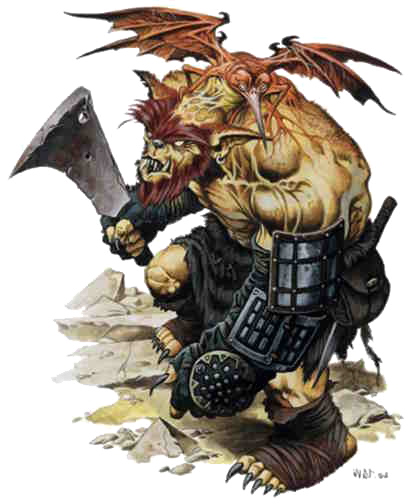
Savage Species, 2003 Wizards of the Coast / Wayne Reynolds
To sum it up briefly, the bugsucker (name given to the bugbear and Stirge combo) gains the special abilities of both; they occupy the same space, and they can’t detach without dealing a ton of damage to both and having to spend a full day of rest to re-attach each other. The biggest upside to this combo is that a bugbear can put you in a bear hug, and the Stirge can drain your blood while you’re getting the greatest, scariest hug in your soon-to-end lifetime.
There’s not much else to the Stirge in this edition; however, we do get information that you can find vast colonies of Stirges on the 88th layer of The Abyss in Fiendish Codex I: Hordes of the Abyss (2006). This layer is Demogorgon’s realm and is known as the Gaping Maw, and even if there weren’t so many Stirges, we still wouldn’t want to vacation there. A point for the Nine Hells is that there are no Stirges reported there in Findish Codex II: Tyrants of the Nine Hells (2006).
4e - Stirge
Level 1 Lurker
Small natural beast XP 100
Initiative +7
Senses Perception +0; darkvision
HP 22; Bloodied 11
AC 15; Fortitude 12, Reflex 13, Will 10; see also bite
Speed 2, fly 6 (hover)
Bite (standard; at-will) +6 vs. AC; 1d4 damage, and the target is grabbed (until escape) and takes ongoing 5 damage until it escapes. An attached stirge doesn’t make attack rolls while grabbing a target and gains a +5 bonus to its AC and Reflex defenses.
Alignment Unaligned; Languages —
Skills Stealth +8
Str 8 (–1) Dex 16 (+3) Wis 10 (+0) Con 10 (+0) Int 1 (–5) Cha 4 (–3)
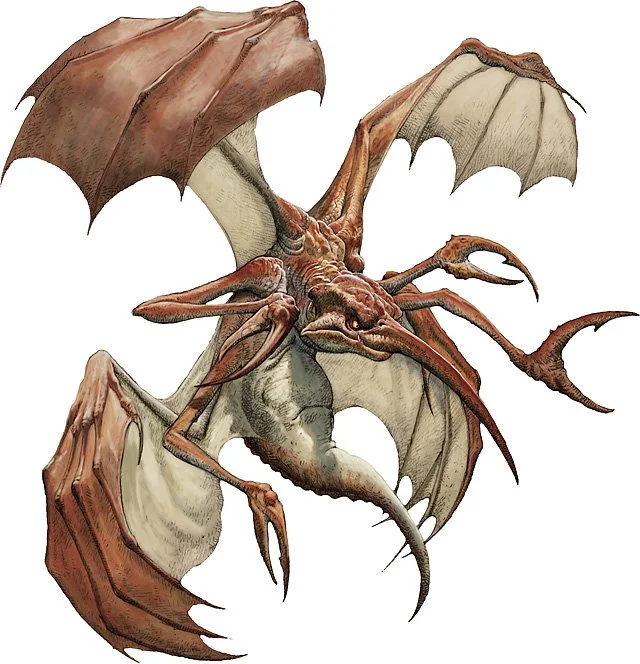
Monster Manual, 2008 Wizards of the Coast / Lars Grant-West
If you thought the heyday for Stirges was in the 2nd edition, welcome to the 4th edition, where the Stirge first appears in the Monster Manual (2008) and in several other sourcebooks, bringing along fresh variants to suck you dry. This edition brings a very creepy old man Stirge art, and it kind of makes us think of Crobat from Pokémon… just less cool and more bloodsucky.
It has four wings in an X pattern, four spindly legs ending in pincers, a stubby tail, and a gross proboscis that looks a bit floppy in the picture but is probably very sharp and stabby. They are reddish brown except for their underside, which looks a bit paler. They are described as batlike horrors, but also as pests and nuisances. They like to gather in large flocks, which is really only when they are dangerous. If you see one by itself, it's not dangerous until it comes back with a flock of its drinking pals.
Despite only having a single page in this book, they have three statblocks with the Stirge, Dire Stirge, and Stirge Swarm. Each is stronger than the last, with a normal Stirge level 1, a Dire Stirge level 7, and a Stirge Swarm at level 12. They are all very similar in that a Stirge lands on you and then begins its delightful, all-drink feast. They first only do a bit of damage when they first bite, they grapple you, and then you take ongoing damage every round until they die, you die, or… well, there is no built-in mechanism for them to reach maximum fullness. Maybe these Stirges can never be satiated. The only difference is that the Stirge Swarm doesn’t grapple you, but you still take ongoing damage.
The last bit of information we get in this book is that there is an old dwarven saying: “I don’t have to outrun the Stirges, I only have to outrun you.” So we’re going to assume that dwarves have been dealing with Stirges for a long time, and this gives credence to Gimli claiming that dwarves were natural sprinters. Hopefully, any dwarves in your party are a bit braver than Gimli.
In Draconomicon: Metallic Dragons (2009), the Stirge returns with a low-level Cave Stirge Swarm. These guys are a lot like a Stirge Swarm, but the cave has made them weak, and they are only level 6. The most interesting thing about these Stirges is that they are part of a orium dragon’s lair, and we suppose that a bloodsucking menace would be a pretty good deterrent for most people poking around your home. (If you don’t know what an orium dragon is, they are a crimson-hued metallic dragon that is obsessed with secrets of the past and only appeared in 4th edition.)
The next Stirges appear in Monster Vault (2010), which shows off 2 new Stirges… however, let’s first talk about kobolds. There is a brief mention that kobolds like to collect all manner of beasts and to train them as pets. One such pet, a bit deadlier than their usual, is a Stirge or cave bear. This is all we need to know that Stirges can be the perfect pet, and you don’t even have to use them as parasites to keep you company, like in 3rd edition.
Now, let’s look at your new pet options. The Death Husk Stirge can blind creatures with a necromantic blast before going in for the blood. Stirge Suckerling Swarm is a ravenous swarm that can quickly launch itself at its enemy, sucking them dry in record time. The third Stirge is the Dire Stirge, and we’ve already told you about how they’re going to grab onto you and never let go until your body is as dry as the desert.
Instead of looking at these Stirges, let’s talk about how various people deal with these terrible insects. These lizard-bat-crab-mosquito hybrids like to hide in sewers, so human cities often abandon the streets at night and batter up their shutters and doors so that Stirges don’t come in for a late-night snack. Dwarves send out heavily armored patrols to wipe out nests, while elves light whole trees on fire if they suspect a flock of Stirges to reside there.
Of course, some creatures actually like Stirges. Necromancers are known to pack flocks of Stirges inside empty chest cavities of undead giants so that the giants gain a ‘breath weapon’ attack to unleash famished Stirges on intruders. Dark mages use Stirges to retrieve blood for their blood rituals, which seems kind of lazy to be honest, but maybe the difficult part is getting Fido the Stirge to drop all the blood it stole. And, as we mentioned, kobolds love their Stirges and incorporate them into various traps to fall on your head while wandering about their home.
5e - Stirge
Tiny beast, unaligned
Armor Class 14 (natural armor)
Hit Points 2 (1d4)
Speed 10 ft., fly 40 ft.
Str 4 (−3) Dex 16 (+3) Con 11 (+0) Int 2 (−4) Wis 8 (−1) Cha 6 (−2)
Senses darkvision 60 ft., passive Perception 9
Languages —
Challenge 1/8 (25 XP)
Blood Drain. Melee Weapon Attack: +5 to hit, reach 5 ft., one creature. Hit: 5 (1d4 + 3) piercing damage, and the stirge attaches to the target. While attached, the stirge doesn’t attack. Instead, at the start of each of the stirge’s turns, the target loses 5 (1d4 + 3) hit points due to blood loss.
The stirge can detach itself by spending 5 feet of its movement. It does so after it drains 10 hit points of blood from the target or the target dies. A creature, including the target, can use its action to detach the stirge.
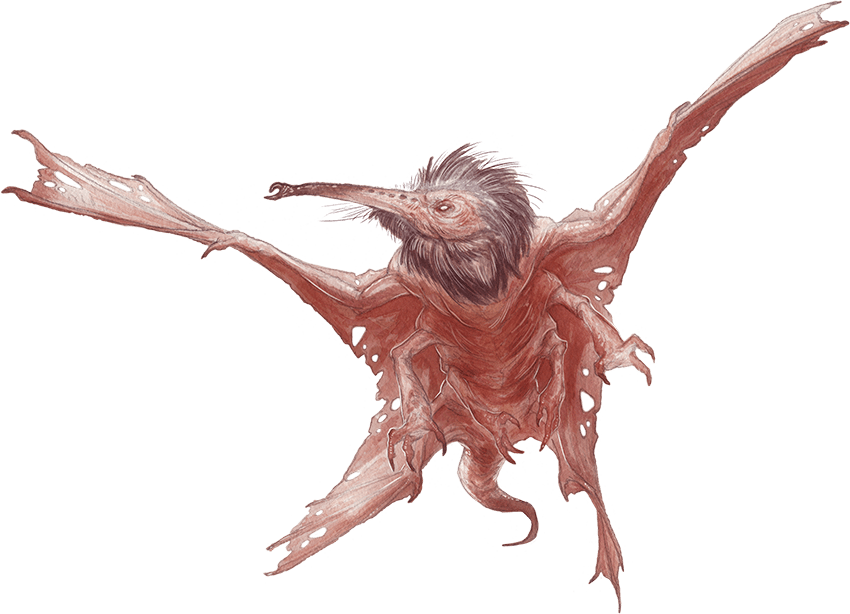
Monster Manual, 2014 Wizards of the Coast / Brynn Metheney
Harkening back to their anteater days, the Stirge is shown off in the Monster Manual (2014) and has a very hairy head compared to the rest of its leathery body. Its long snoot is a lot like an anteater, and we’d almost call it cute if we didn’t know it wanted to drain all of our blood.
The Stirge is back to its old game of hit you with the snoot, deal a bit of damage, and then every round after that suck away 1d4 + 3 hit points. Once the Stirge has drained 10 hit points, the target dies, the Stirge dies, or it’s done drinking you dry and detaches before flying off. Of course, you can stop that, by either dying, killing the Stirge, or just using an action to rip it off. No longer does it hurt you, no longer is it difficult to do, you just use an action and pry it off. Seems like it would be harder to pry your dog out of the peanut butter jar (you’re blood is the peanut butter in this metaphor).
While the Stirge appears in plenty of adventures, like in every other edition, its next incarnation is weirder than any other version. In Van Richten’s Guide to Ravenloft (2021), we are introduced to the Strigoi which are the result of wizards, once again, going too far. They are said to have been first created by spellcasters, subjecting swarms of Stirges to transmutation spells, and they do look like a human-Stirge hybrid that threatens to haunt our nightmares.
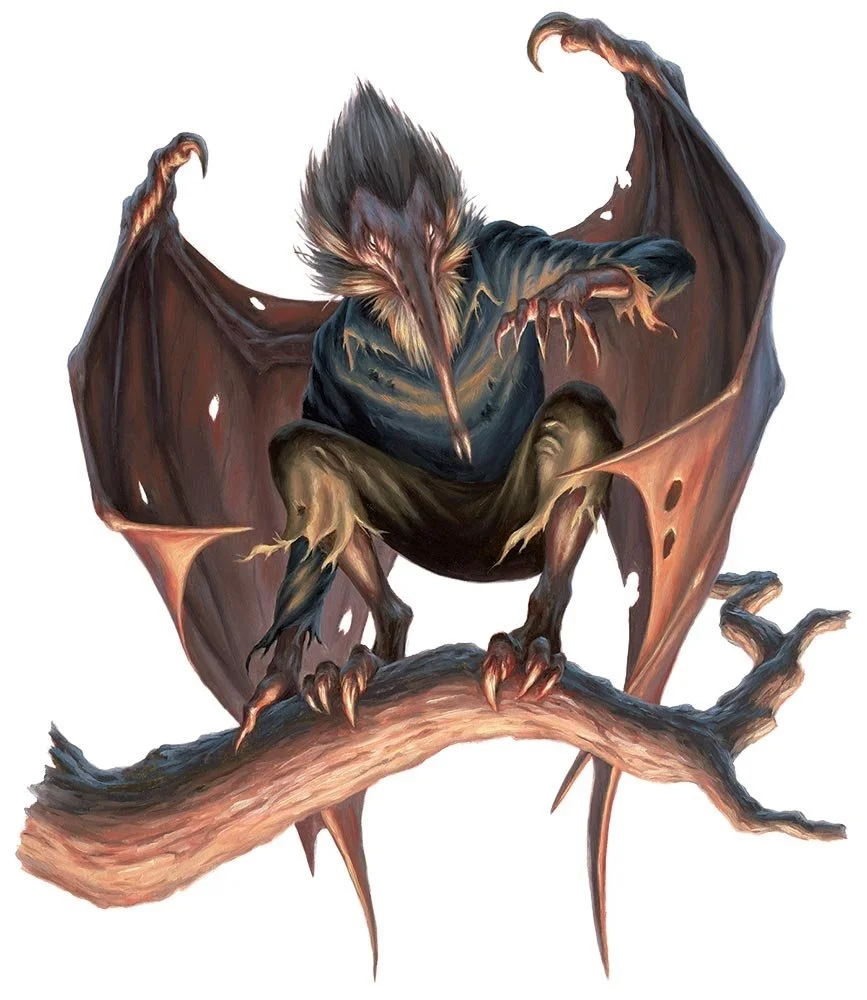
Van Richten’s Guide to Ravenloft, 2021 Wizards of the Coast
They are as big as a human with arms and legs ending in terrible claws, the head of a Stirge, and large bat wings. They not only drain blood, but marrow and soft tissue, so if you are looking to lose weight, maybe hang out with them for a bit. Of course, we can’t lay the full blame for Strigoi at the feet of wizards, but we sure would like to. Vampires are also indirectly responsible for their creation, as Stirges will go after well-fed vampires, which means your blood could be feeding multiple creatures. When a Stirge does so, it might contract some weirdness and become a Strigoi.
Strangely enough, it seems like Strigoi aren’t very happy with their lives. It is said that they seek to return to their former existence, which is a bunch of individual Stirges in a swarm. However, some Strigoi really like their new look and have even set up faux-aristrocrat Strigoi that lead Stirge courts in abandoned villas. It’s a really strange turn for the Stirge, but we’re happy to have a new monster to throw at our party to make them hate us even more.
The next time we see the Stirge, they are back to normal in the 2024 Monster Manual. They look a bit more fearsome with fur that covers their back and a darker red and bigger proboscis-snout. All of their lore is replaced with a single sentence about how individuals are annoying, but several can be deadly. Which is pretty disrespectful. Stirges have been around since 1975; they have 50 years of lore, and they deserve better.
Luckily, we do get a Swarm of Stirges, also with a single sentence description about living in swamps and the Underdark, and a dumb line about how they eat creatures who can’t escape them. The swarm is what you would expect and is just a slightly meaner version of a normal Stirge. Nothing exciting about either one here, and with no lore to sink our teeth into, the Stirge fizzles out.
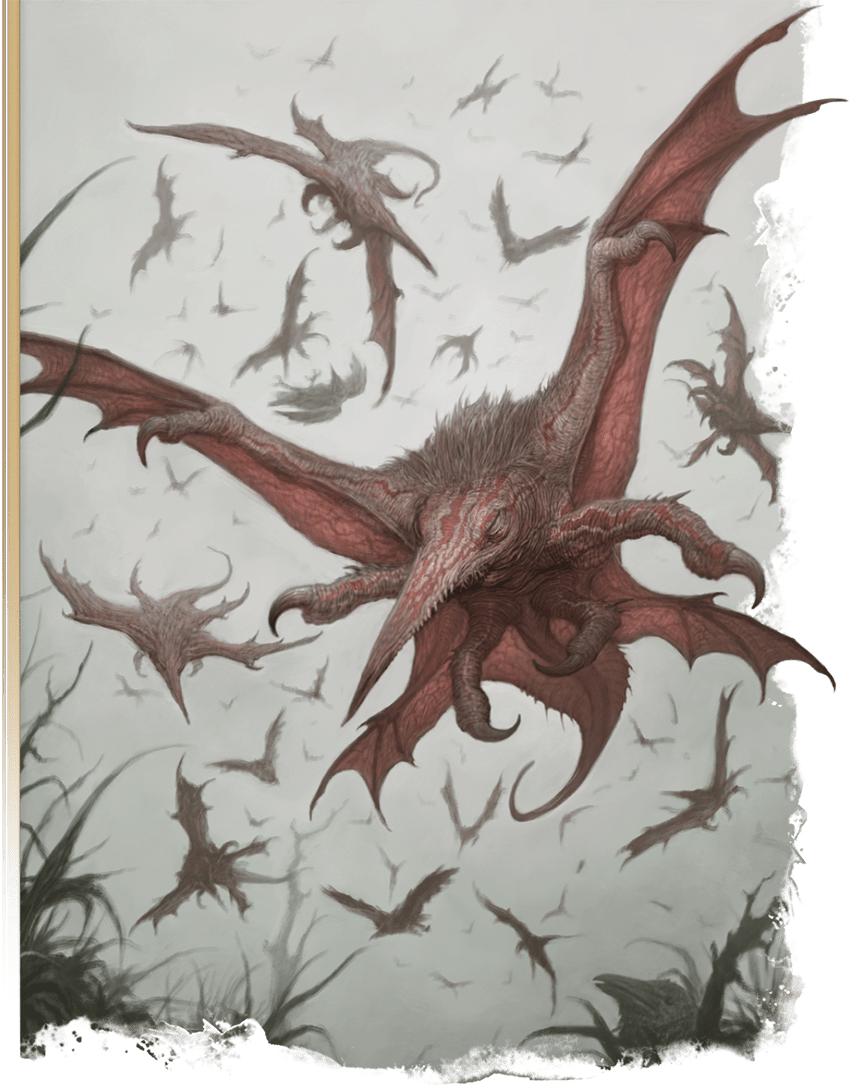
Monster Manual, 2024 Wizards of the Coast / John Tedrick
So let’s summarize this masterpiece of evolutionary design. The Stirge is a terrifying bat-mosquito-crab-anteater-lizard-insect conglomeration of terror. A single one is basically just a fancy pinprick with wings, arguably less threatening than a hangnail. The problem is they travel in packs because mediocrity loves company. Encounter a large enough group of them, and you’ll probably end up as their communal juice box.
If you enjoy our Deep Dive series, consider
supporting us on Patreon
and following us on Facebook and Instagram!