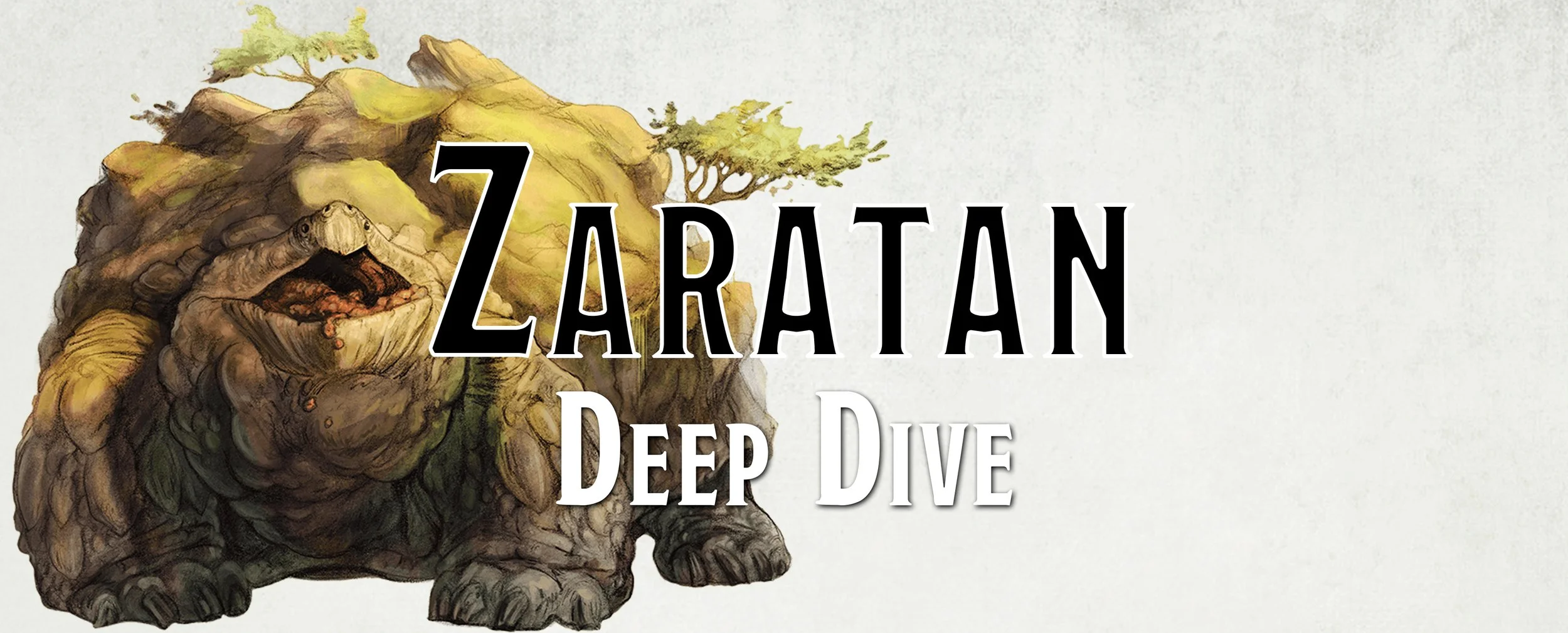
Deep Dive - The Zaratan
Also known as a Saratan, the Zaratan is a colossal sea creature, typically depicted as a giant turtle. In early Arabic folklore, it was described as a gaint crab and that sailors would not realize it was a creature, but rather an island. They would land on the island, gather wood and light a great fire. When the Saratan felt the heat, it would attempt to swim away from the flames, taking with it some of the sailors who were not able to escape back to their ship.
The popular idea of Zaratans comes from Jorge Luis Borges with his work The Book of Imaginary Beings (1957). He describes them as giant turtles, the size of islands, and with long-life spans. Which leads us to Dungeons & Dragons and massive turtles that can shoot rocks from their mouths.
2e - Zaratan
Climate/Terrain: Tropical / Fresh and salt water
Frequency: Very rare
Organization: Solitary
Activity Cycle: Any
Diet: Omnivore
Intelligence: Average (8-10)
Treasure: See below
Alignment: Neutral
No. Appearing: 1
Armor Class: -6/0
Movement: 1, Sw 2
Hit Dice: 51-70
THAC0: 5
Damage/Attack: 10-100
Special Attacks: Swallow
Special Defenses: Immune to poison, magic weapon needed to pierce shell
Magic Resistance: Nil
Size: G (200’-350’ diameter)
Morale: Fearless (19)
XP Value: 46,000 + 1,000 per HD over 51
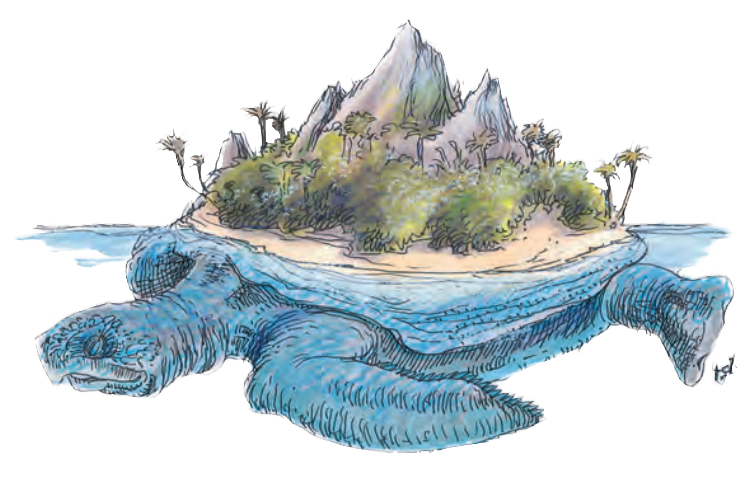
First introduced in Monstrous Compendium: Al-Qadim Appendix (1992) and reprinted in Monstrous Manual (1993), the Zaratan is an enormous, passive turtle found in warm seas. Zaratani have massive shells that look like sloped, rocky mounds that are several hundred feet in diameter. Their heads are over 50 feet across and are mistaken for barnacle-encrusted boulders, and they have four flippers over a hundred feet long, covered in corals, barnacles, and small fish that make their home there. When asleep, which is most of its life, it appears like a floating island.
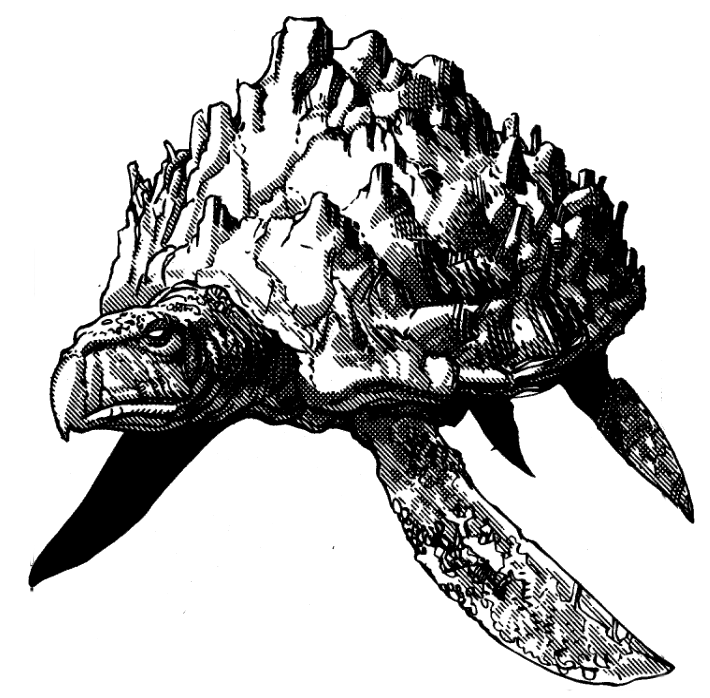
Monstrous Compendium: Al-Qadim Appendix, 1992 TSR Inc / Tom Baxa
As we mentioned, Zaratani like to sleep, like even more than teenagers. Zaratani slumber for up to 100 years at a time, only waking to eat, converse with others of their kind, or to mate. Once they accomplish these tasks, they go back to sleep. Now, you might be wondering how these magnificent creatures survive their extended slumbers. Since they are adrift at sea, they keep their mouths open while sleeping, and curious fish (and adventurers) get sucked into the stomach and consumed.
If you are unlucky enough to get trapped in there, fear not. Just like Jonah, you can survive inside these massive stomachs off of the stale air inside, plus all the half-digested fish you could ever eat. You do have to worry about the corrosive digestive juices, but you only suffer 2 damage per day from it, so you’re probably fine for at least a day. In addition, Zaratani swallow random stuff, so you might find weapons, armor, driftwood, chunks of ships, and anything else that has accumulated in the stomachs of these great reptiles over thousands of years.
If you want out, you’re going to have to deal at least 5% of the Zaratan’s health in damage to it. Since they have 51 to 70d8 HIT DICE, you might be at that task a while. This translates to an average of 229 to 315 hit points, or a max of 580 hit points. Once you reduce its hit points by 5%, it’ll then regurgitate everything in its stomach, spewing you unceremoniously out into the ocean. If you happen to wake up the Zaratan, it is going to be very upset with you.
You see, once you deal at least 5% of its hit points in damage, the Zaratan starts fighting back. Before, it would’ve hid in its shell, but now that you’ve angered it, it is going to chew you up real good, and then you swallow you again. Luckily for you, because Zaratans are so big and slow, they always go last in a combat round, so you have a chance to try and escape. If you decide not to immediately swim away, it will bite you for 10 to 100 damage. This probably kills you.
Now that you’re dead, it immediately goes back to sleep for up to 100 years.
Monstrous Manual, 1993 TSR Inc / Tony DiTerlizzi
If you want to try your luck at killing these creatures, good luck. Only magical weapons can pierce its shell, and no known poison can affect a Zaratan, as they have an incredibly slow metabolism. Lastly, they are floating on warm seas, so fire isn’t going to be the solution either. Plus, with its hundreds of hit points, you probably aren’t going to kill it before it bites you a second time.
The last bit of lore we have on the Zaratan is that because they are so large, many people have taken up residence on them. So long as you don’t hurt or bother its sleep cycle, the Zaratani don’t particularly care about people living on its shell. This has led to pirates and raiders utilizing them as a home base, island villagers who sacrifice great catches of fish to their island god, and shipwrecked survivors thanking the gods for a dry piece of land.
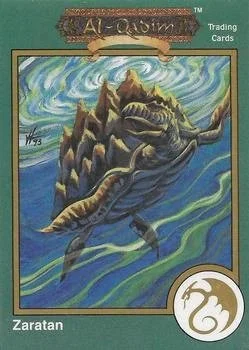
AD&D Trading Cards 1993, TSR Inc / Valerie Valusek
Eventually, though, the Zaratan will wake up, and you’ll have to contend with it hunting, mating for over a year with another Zaratan, telepathically talking to other nearby Zaratan, or simply deciding to go for a swim in the deepest sections of the ocean.
The Zaratan does appear in an interesting adventure called Floating Rock written by Steve Kurtz in Dungeon #46 (March/April 1994). A group of bugbears has landed on a Zaratan, found out it is alive, and named this ‘holy site’ Floating Rock. In the adventure, these bugbears act as raiders, leading devastating nighttime raids on passing ships, taking crews hostage, then returning the prisoners to their floating island, where they have a great feast and sacrifice the prisoners to the Zaratan. It’s likely the adventurers will be sacrificed in this adventure, and it is up to them to free themselves from the Zaratan’s stomach and the tribe of bugbears holding a drunken celebration.

Dungeon #46, March/April 1994 TSR Inc / David O. Miller
3e - Zaratan
Colossal Magical Beast
Hit Dice: 38d10+345 (554 hp)
Initiative: +0
Speed: 10 ft., swim 30 ft.
AC: 32 (–8 size, +30 natural), touch 2, flat-footed 32
Attacks: Bite +46 melee
Damage: Bite 4d6+24
Face/Reach: 80 ft. by 100 ft./40 ft.
Special Attacks: Fin sweep
Special Qualities: Darkvision 60 ft., low-light vision
Saves: Fort +30, Ref +21, Will +16
Abilities: Str 43, Dex 11, Con 28, Int 6, Wis 19, Cha 12
Skills: Listen +12, Spot +12, Swim +24
Feats: Alertness, Toughness
Climate/Terrain: Warm aquatic
Organization: Solitary
Challenge Rating: 20
Treasure: Double standard
Alignment: Usually neutral
Advancement: 39–76 HD (Colossal)
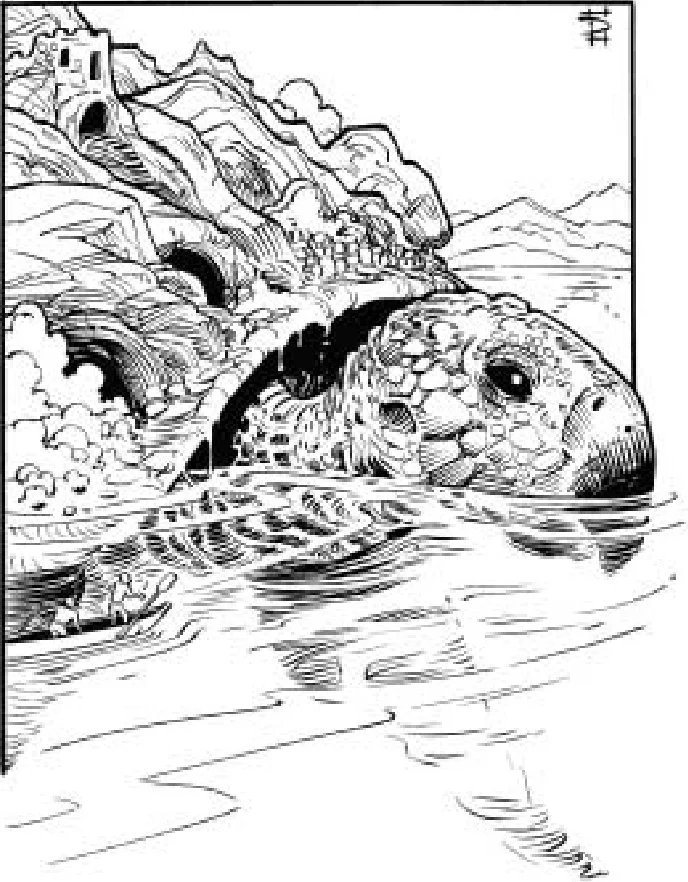
Arms and Equipment Guide, 2003 Wizards of the Coast
A devastating blow to the Zaratan’s reputation, the Zaratan doesn’t appear in any true book of monsters, but rather in the Arms and Equipment Guide (2003) in the “Hirelings and Creatures” section. Luckily, the Zaratan is most likely sleeping through this edition (and the next), so it’s probably not going to go on a rampage at this demotion.
Now, you’re probably wondering why the Zaratan appears in a section about hirelings and mounts, and it’s because you can technically use one as a ship. But only if you are incredibly patient, incredibly persistent, and have a few friends you don’t mind sharing the profits of capitalism with. Zaratan are slow. They are slow to follow orders, slow to swim, and slow to do anything but sleep.
To get a Zaratan to sail where you want to go, and not just with the currents, you need to stand near its head and give your orders over and over. This could be shouting, singing, or words of encouragement as you make a DC 31 Diplomacy, Intimidate, or Perform check. If you fail that, the Zaratan remains in its natural lethargic state. If you succeed, you need at least three other people around the shell to stamp their feet, hit the shell with bludgeoning weapons, or anything else in case the turtle goes off course. These vibrations are unpleasant, and the Zaratan will naturally pull away from those vibrations, and you’ll stay on course. Also, as the pilot of the USS Zaratan, you'd better get used to doing this constantly, as they’d rather sleep than do whatever it is that you want.
Let’s say, as an example, you have failed to get the Zaratan to listen to you, and you accidentally hurt the big turtle. Its response to combat is to first withdraw its head and flippers into its shell. If you keep up the violence for another two rounds, it lashes out, biting and sweeping its fins all around it. It then attempts to flee the next round and followed by attacking again. It continues fighting and fleeing until you’re dead, you’ve left it alone, or it has escaped.
Getting bit is awful, but luckily, it isn’t 100 points of damage awful, only an average of 38 points of damage awful. In addition, if you’re in the water, it’ll buffet you with its thrashing fins, dealing around 25 bludgeoning damage to everyone within 40 feet of it. The only bright spot fighting Zaratan is that it isn’t immune to poison anymore, so at least your rogue can finally start pulling their weight.
Lastly, Zaratans are exceedingly rare, especially young Zaratan. They live for thousands of years, so no one has really been able to train them properly, since it probably takes hundreds or thousands of years to do so. So don’t try and think you’re going to get the floating island to listen to you. A Zaratan might put up with your commands for a little bit, but the moment you start disturbing its rest too much, it’s diving underwater and getting rid of its pesky hangers-on.
5e - Zaratan (Elder Elemental)
Gargantuan elemental, neutral
Armor Class 21 (natural armor)
Hit Points 307 (15d20 + 150)
Speed 40 ft., swim 40 ft.
STR 30(+10) DEX 10(+0) CON 30(+10) INT 2(−4) WIS 21(+5) CHA 18(+4)
Saving Throws Wis +12, Cha +11
Damage Vulnerabilities thunder
Damage Resistances cold, fire, lightning; bludgeoning, piercing, and slashing from nonmagical attacks
Damage Immunities poison
Condition Immunities exhaustion, paralyzed, petrified, poisoned, stunned
Senses darkvision 60 ft., tremorsense 60 ft., passive Perception 15
Languages —
Challenge 22 (41,000 XP)
Earth-Shaking Movement. As a bonus action after moving at least 10 feet on the ground, the zaratan can send a shock wave through the ground in a 120-foot-radius circle centered on itself. That area becomes difficult terrain for 1 minute. Each creature on the ground that is concentrating must succeed on a DC 25 Constitution saving throw or the creature’s concentration is broken.
The shock wave deals 100 thunder damage to all structures in contact with the ground in the area. If a creature is near a structure that collapses, the creature might be buried; a creature within half the distance of the structure’s height must make a DC 25 Dexterity saving throw. On a failed save, the creature takes 17 (5d6) bludgeoning damage, is knocked prone, and is trapped in the rubble. A trapped creature is restrained, requiring a successful DC 20 Strength (Athletics) check as an action to escape. Another creature within 5 feet of the buried creature can use its action to clear rubble and grant advantage on the check. If three creatures use their actions in this way, the check is an automatic success. On a successful save, the creature takes half as much damage and doesn’t fall prone or become trapped.
Legendary Resistance (3/Day). If the zaratan fails a saving throw, it can choose to succeed instead.
Magic Weapons. The zaratan’s weapon attacks are magical.
Siege Monster. The elemental deals double damage to objects and structures (included in Earth-Shaking Movement).
Multiattack. The zaratan makes two attacks: one with its bite and one with its stomp.
Bite. Melee Weapon Attack: +17 to hit, reach 20 ft., one target. Hit: 28 (4d8 + 10) piercing damage.
Stomp. Melee Weapon Attack: +17 to hit, reach 20 ft., one target. Hit: 26 (3d10 + 10) bludgeoning damage.
Spit Rock. Ranged Weapon Attack: +17 to hit, range 120 ft./240 ft., one target. Hit: 31 (6d8 + 10) bludgeoning damage.
Spew Debris (Recharge 5–6). The zaratan exhales rocky debris in a 90-foot cube. Each creature in that area must make a DC 25 Dexterity saving throw. A creature takes 33 (6d10) bludgeoning damage on a failed save, or half as much damage on a successful one. A creature that fails the save by 5 or more is knocked prone.
Legendary Actions
The zaratan can take 3 legendary actions, choosing from the options below. Only one legendary action option can be used at a time and only at the end of another creature’s turn. The zaratan regains spent legendary actions at the start of its turn.
Stomp. The zaratan makes one stomp attack.
Move. The zaratan moves up to its speed.
Spit (Costs 2 Actions). The zaratan uses Spit Rock.
Retract (Costs 2 Actions). The zaratan retracts into its shell. Until it takes its Emerge action, it has resistance to all damage, and it is restrained. The next time it takes a legendary action, it must take its Revitalize or Emerge action.
Revitalize (Costs 2 Actions). The zaratan can use this option only if it is retracted in its shell. It regains 52 (5d20) hit points. The next time it takes a legendary action, it must take its Emerge action.
Emerge (Costs 2 Actions). The zaratan emerges from its shell and uses Spit Rock. It can use this option only if it is retracted in its shell.
The Zaratan goes through a major change in its lore, but at least it appears in this edition in Mordenkainen’s Tome of Foes (2018) and is reprinted with stripped-down lore in Mordenkainen Presents: Monsters of the Multiverse (2022). No longer will you find this island turtle lazily floating along warm currents, but rather now it plods across the landscape. Its habitat is not the ocean, but rather the desert, forest, grassland, hills, mountains, and Underdark. This is because it is no longer a beast, but an elemental being known as an Elder Elemental.
Elder Elementals are beings of immense power, often considered to be apocalyptic when they arrive, bringing about destruction. There are lost temples that honor these elementals, and a cult known as the Elemental Evil that hopes to summon these cataclysmic elementals in the hope of destroying the world. When a Zaratan is summoned, it rises from the ground and takes the shape of a massive turtle, its shell composed of the surrounding landscape.
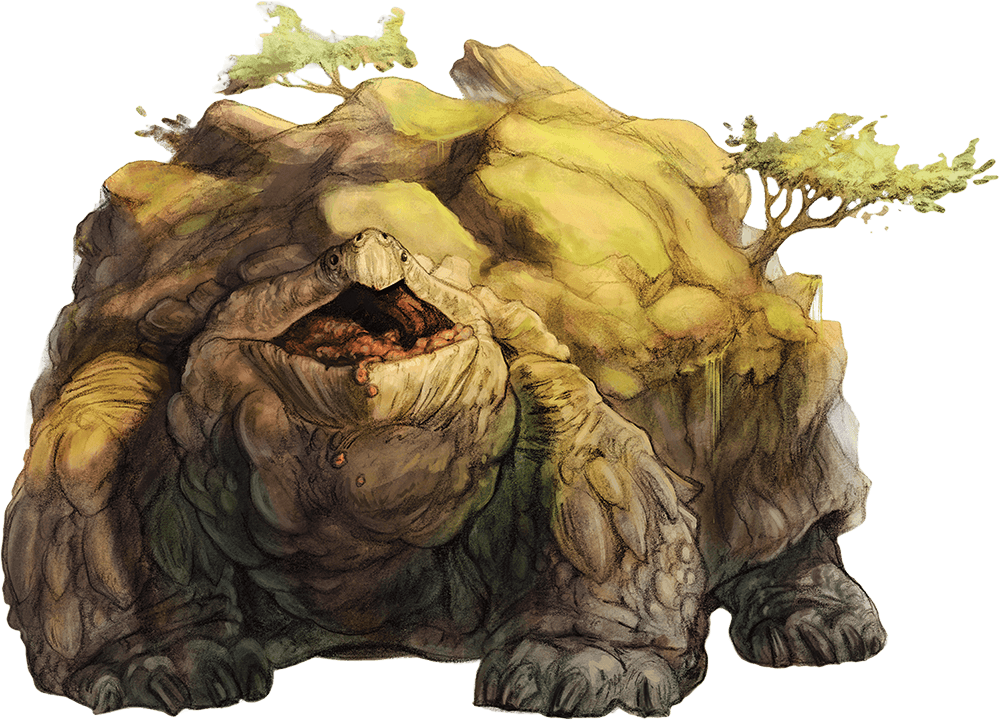
Mordenkainen’s Tome of Foes, 2018 Wizards of the Coast / Brynn Metheney
They are now dim-witted creatures, a turn from the previous editions, where they had average intelligence. People merely assumed they were unintelligent due to their sloth-like nature and lack of motivation to do more than vibe their way through life.
If you get in a fight with these creatures, get ready to get stomped. They not only bite, but they smash creatures underfoot, spit forth rocks, and cause the ground itself to quake with their movements. Defeating such creatures is also difficult since they are resistant to cold, fire, lightning, and nonmagical weapons, and outright immune to poison, though they are vulnerable to thunder damage. This is kind of a rare damage type, especially since there are only 8 spells in the 2014 Player’s Handbook that even deal thunder damage.
While the Zaratan still retains its Swim speed, probably just as a loose tie to its origins, it is a being of elemental earth. It spews boulders and dirt from its mouth and is better described as a turtle hill, not a turtle island.
The Zaratan, first found in Arabic folktales, is a creature of the ocean (at least, until that one edition). It is a safe haven for shipwrecked sailors, an incredible companion for a merchant not bothered about where they sell their goods or keeping to a schedule, and as one of the creatures responsible for a cataclysmic apocalypse. These Zaratan are ripe for adventure on the high seas, though if you happen to see one on a high mountain, just know it’s the end of days.
If you enjoy our Deep Dive series, consider
supporting us on Patreon
and following us on Facebook and Instagram!