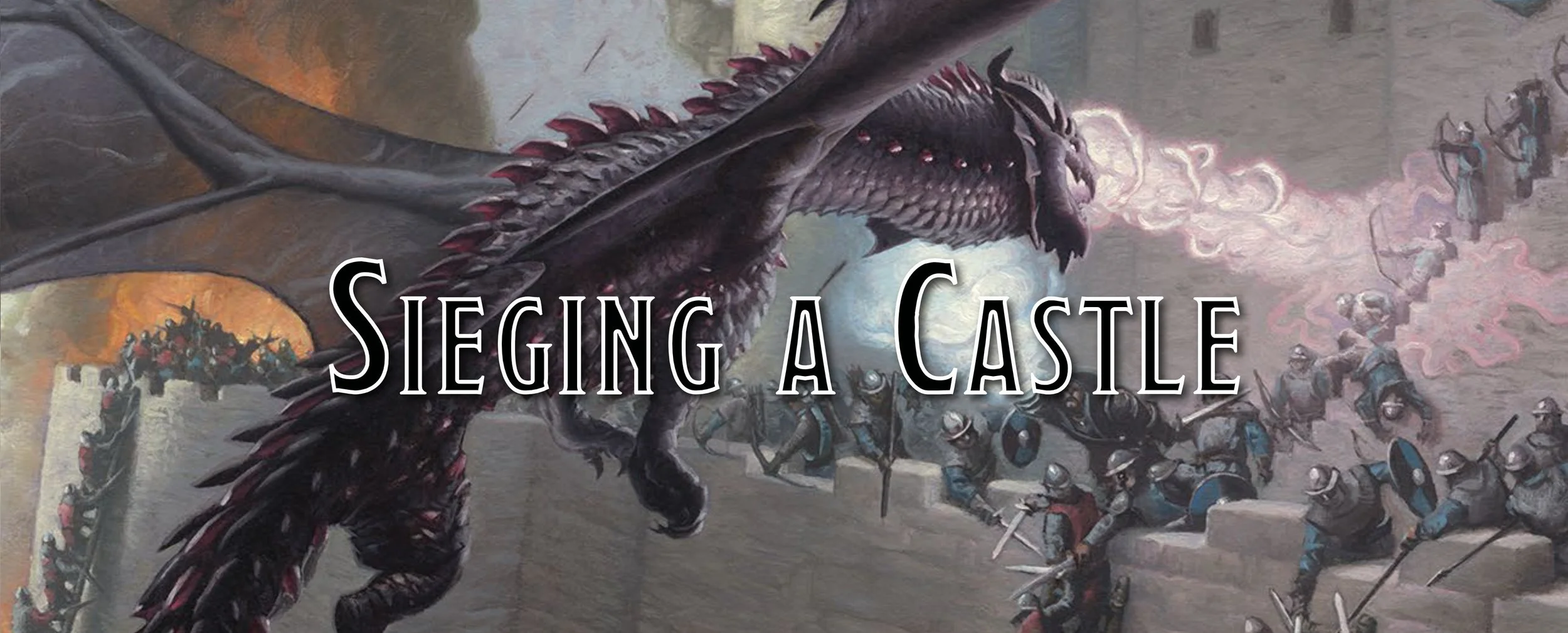
How To Siege a Castle in D&D
While some may think of a castle as the final refuge of the incompetent, castles are powerful defensive structures that can withstand hordes of enemies. In a world of magic, castles remain an important defensive structure (even if the Earthquake spell can knock a wall or two down).
We are looking at how to siege a castle, and how to defend it from the hordes outside it.
Moats
A moat is a deep, wide ditch that wraps around a castle. It can be filled with water or left dry, and is there to make it difficult to approach the walls or use siege equipment (such as a ram or siege tower).
For the defenders, you might keep the moat stocked with hungry fish or dire lizards (or summon beasts and elementals with spells) that a druid has convinced to eat anyone who attempts to cross the moat, or have illusory bridges leading into the castle via the Phantasmal Force spell that confuses the army. When armies come to siege the castle, you can cast Water Breathing on an elite squad and have them hide under the water, striking out at anyone who attempts to swim or wade the moat.
For attackers, there are many spells that you can use to bypass this danger. You might use Water Walk to have soldiers run across the water like it was a solid surface or use Control Water to part the water or cause it to flow up the walls and into the enemy castle. You also can create bridges with Wall of Stone, Mold Earth, or any other number of spells that shape and twist the elements of water and earth.
Castle Walls
Surrounding a castle are its defensive walls. These might be wood (for quickly and cheaply erected) or stone (for more permanent structures with a lot of funds), and they can range in size from 15 to 40 feet tall and 3 to 20 feet thick.
For defenders, a thick and sturdy wall represents protection. Arrows, siege boulders and ballistae, and the constant onslaught of magic is nothing against reinforced stone. If the walls are damaged, a quick Fabricate spell for smaller holes, or a Wall of Stone spell for bigger breaches, can quickly reinforce your walls. For those hoping to keep outsiders from scaling the walls, a Grease spell targeting the walls or a siege ladder can make it even harder for the enemy to storm the walls.
While a Wall of Stone spell can be used as a quick patch, it is only 6 inches thick (instead of the 3 to 20 feet thick that a wall needs). It can quickly fill a gap, and a spellcaster can stack multiple panels back-to-back to thicken the thin magical wall. If the gap is too large, then they might use Levitate to lift smaller stone blocks into place (the spell is limited to 500 pounds, which will translate to blocks that are slightly smaller than two feet high, wide, and long) or use Stone Shape to fill the hole with the surrounding material.
Attackers have just as many spells, if not more, that they can use to move over, under, and even through walls. A Wall of Stone spell can be just as effective for attackers as it can create stairs leading to the top of a wall, a Passwall spell to literally move through the wall, and even Stone Shape to push the stone out of the way. If those are too high-level spells for your attackers, they can use 2nd-level spells like Levitate or Jump to launch attackers to the top of the walls, bypassing the need for siege ladders or climbing.
Flying Creatures
While our castles are designed for attacks from the ground, that isn’t to say that we have no experience against aerial assaults. Boulders, ballistae, corpses, burning detritus, and more were all flung over walls in an attempt to bypass them. Fortified roofs, nets, and more were developed and used to catch and protect those under it from attacks.
For defenders, flying can leave them exposed. Castle walls rarely float alongside you, and you can quickly become the main target of attackers outside the walls. That said, flight provides options for the castle to restock on needed supplies by bypassing the enemy (if they are willing to risk their flying troops), get a better lay of the land and troop positions, as well as launch attacks from above.
In addition, defenders will have to defend their castle with ballistae that can point straight up (to hit griffons or pegasus knights) and keep a wary eye on the sky in case a flock of wyvern knights or a dragon attempts to use cloud cover to launch a surprise attack from.
For attackers, flight offers another dimension to launch their attack from. Depending on their resources, they might be able to grant magical flight to their more powerful warriors who will attempt to break the siege or sneak into the castle and lower the gates, or they may have a battalion of griffon riders who rip and tear through defenders on top of the walls while the rest of the army moves forward.
Magic
Beyond the uses for spells we’ve already mentioned above, there are many more that can be used by either side to help obscure and destroy. A Stinking Cloud spell can quickly disperse defenders from the top of a wall or cause attackers to retch and give up the attack. Speak with Animals can help armies gather intelligence from mundane beasts that have been trained to spy on their enemies. Feather Fall can help save lives from those who fall off siege towers or castle walls, and a Clairvoyance spell can help you spy on your enemies in their command tents or castles.
There are also magic items that are invaluable. A Wand of Secrets can let an invading army find secret tunnels and entrances into the castle, a Ring of Spell Storing can be stocked with versatile spells like Silence, Dispel Magic, or even Wall of Stone so that non-spellcasters can quickly react while spellcasters are deal with other problems. Even uncommon items, such as a Rope of Climbing can provide a quick and silent means for a small group of adventurers to breach the castle walls and sneak over the top, perhaps under the cover of an Invisibility or Pass Without Trace spell.
Illusions can also be highly effective. From convincing attackers that a destroyed wall is still standing to the sight of horrible monsters that may be real or conjured into existence, soldiers will have to first risk their lives to prove that such monsters aren’t real. There are also enchantment spells, like Suggestion or Domination. By causing a single soldier in a mass to suddenly strike out at its allies, you can create mass confusion that would far exceed a Confusion spell (but you could also cast that on your enemies, too).
Laying Siege
When laying siege to a castle, magic and creative thinking can help overcome even the thickest and largest walls. When spells are being flung back and forth across the battlefield, the real decider of battle will be who can outthink the other (or whoever has soldiers left after the final Meteor Swarm is cast).
Like what we do?
Join our Patreon!
You’ll get early access to deep dives, the Homebrew Hoard
featuring 500+ monsters, ad-free articles, and more!
Follow us on Reddit to keep up to date on everything we talk about!