Mistborn: The Final Empire - Remaking Appendix N
Continuing our epic quest to find new books to include in a revamped Appendix N, we are looking at Mistborn: The Final Empire (2006) by Brandon Sanderson.
For those who aren’t aware, Appendix N was a collection of books that Gary Gygax put together for Dungeon Masters looking for inspiration for their Dungeons & Dragons games, and appeared in the first Dungeon Master’s Guide released in 1979. As you can probably guess, a ton of new books, video games, music, and paratext have come out that DMs and players alike should be reading, consuming, and watching to inspire their own games.
That’s what we are doing, going over media that I think should belong in a revamped Appendix N, and I’m not just sticking with books… that said, the first two things I’ve done are books so like… maybe we’ll fix that for next time!
What’s Next
Before we get into things, it’s time to share what will be next! Since I want to avoid doing another book, we’re going to check out a movie all the way from 1981! Since our rule is no old content with a cutoff of 1980, this one barely slides in, or should I say ‘flies in?’
We are going to be watching Dragonslayer (1981) by Matthew Robbins and Hal Barwood. I hope you’re as excited as me, cause I think I only watched this movie once when I was like 10, and all I remember is seeing someone’s butt on screen for the first time. I’m excited to revisit this film as I see it recommended all the time for those looking for a great fantasy movie starring a dragon.
Mistborn: The Final Empire by Brandon Sanderson
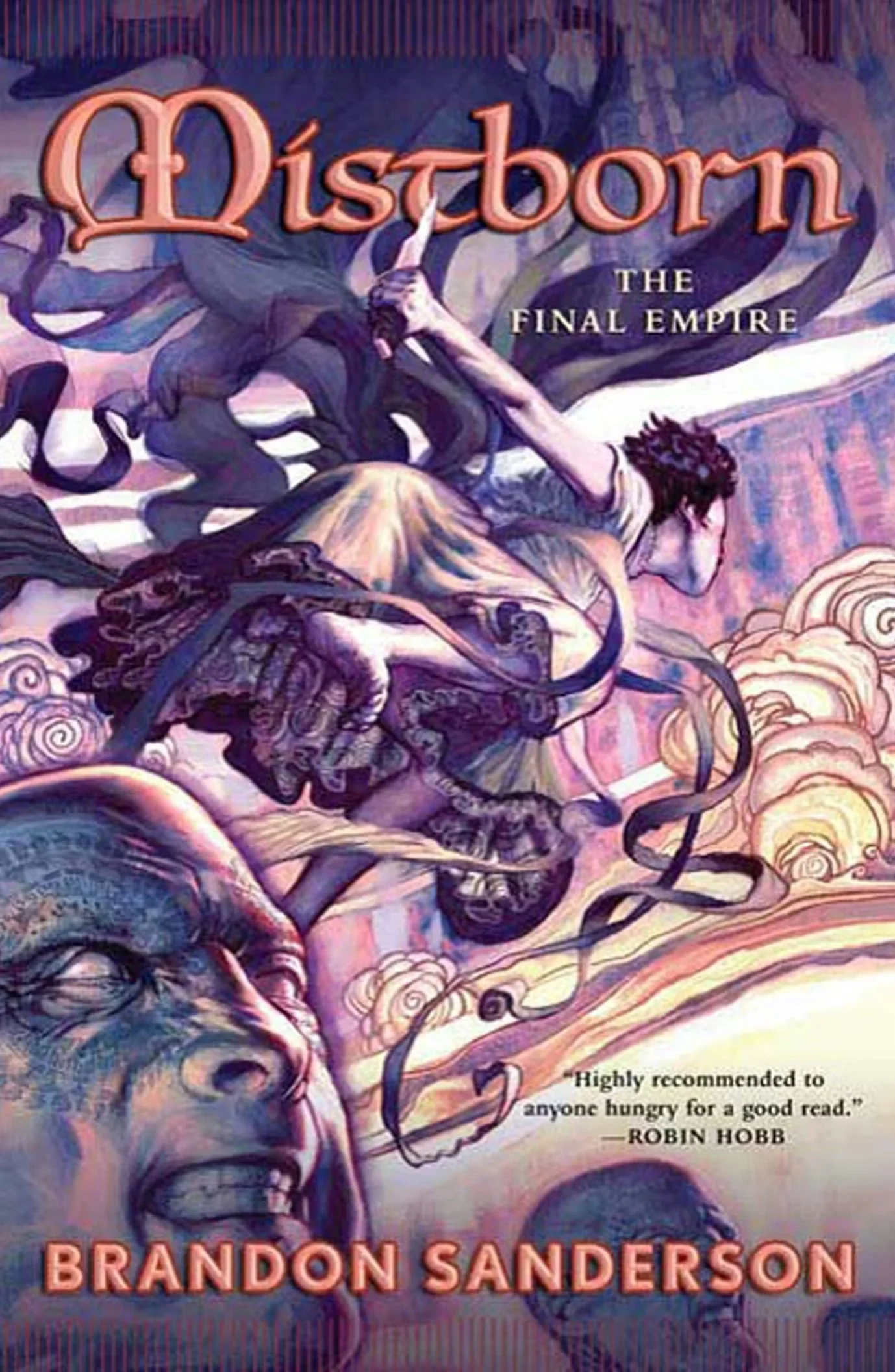
Released in 2006, I hadn’t read this book until about 18 years after its release. I’m a little late to the party. That said, I can at least say that I like this book without nostalgia playing a role in that opinion (sorry, Eragon, it might be nostalgia talking, but I still like you <3 ).
As for the author, I haven’t read anything else from him except the three books in this Mistborn series. That said, I would like to read more of his work, and I have seen a few talks he has done, most recently this one on AI and artists.
As I’ve already read the series once before, I have… some opinions on the ending of the series. That isn’t to say that you shouldn’t read it, or I don’t recommend it, or that the ending isn’t a good fit for the story. But a part of the ending just rubs me the wrong way in terms of modern sensitivities, and I’ll leave it at that (it was 20 years ago when the series was written, after all).
Review
It’s now time to share my thoughts on this single book, not the series in general. Since I’m only reviewing the one book, it wouldn’t be fair to lump the entire series into this review. Just want to put that out there.
4/5
It’s a good start to an interesting series, but it can feel like a slog to read through it (and I did the audiobook version). I have some complaints about the writing, like how he overuses “said” constantly in conversation and it gets really annoying (that might be an audiobook issue, maybe it isn’t annoying when using your eyeballs). There will be two characters talking back and forth, and it’ll keep clarifying who is talking by saying “Vin said” followed immediately by “Elend said” followed by “Vin said” followed by “Elend said,” and it just gets annoying. Yes, I know that is a trivial thing to complain about, but here we are. It jumped out at me multiple times in this book, and the series at large.
Next, I think the book itself could’ve been tightened up. It’s a chunky 500+ page hardcover book with around 215,000 words. That’s a big book and requires a bit of a commitment from casual readers (which I feel like I fall into that category, depending on how life is treating me). Is it worth the squeeze?
Yes, the book’s ideas are great, and I haven’t seen them replicated anywhere else. This is a really interesting world, even if you don’t explore much past the city of Luthadel, and the entire world feels a bit… small. That’s a bit weird to say, but I’ll try to explain it more. We get a ton of information about the setting, but it’s all about one place, the capital of the Final Empire. I don’t really have a firm idea where the city is in the world of Scadrial, but I have a solid understanding of the city and its political place in the world, and how important it is. Again, it’s a weird feeling to have.
My favorite part, and I assume this is true for most people, is the magic system. If you don’t know, the magic system is called allomancy and is a magic ruled by metal. Allomancers can consume flakes of metal and then ‘burn’ that metal to empower them, and allomancers can either only use one type of metal or all types of metal. They gain different powers based on the metal, so burning steel lets you push nearby metals away from you, tin increases your physical senses, bronze lets you detect people using allomancy, while brass dampens emotions. There are 10 known metals, with an “eleventh metal” hinted at in the book that will bring about the downfall of the Lord Ruler, the main antagonist in the book.
The uses of these metals are very interesting, and the author has definitely spent a lot of time thinking about how they would interact in the world and affect things.
Goes on the List?
Should The Final Empire join Eragon on our exclusive list for a revamped Appendix N?
Absolutely. There is a reason Brandon Sanderson is one of the great fantasy writers (and it isn’t cause he writes good romance). This is a book to be mined for inspiration, even if it is just helping you imagine a world where magic is real, and how it might impact the politics and fighting in that world.
Mistborn: The Final Empire
The book starts out showing the caste divide between nobles and the skaa, who are both humans. There is no actual difference between the two except the nobles have a bloodline that is clean and pure, while the skaa have a bloodline that is dirty and bad. Nobles think of skaa as slightly better than animals, mistreating them and killing them without a second thought. This caste system is ruled over by the Lord Ruler, a powerful man who is also a god and has ruled for a thousand years after saving the world from some nebulous evil known as the Deepness.
The book largely follows Vin, a street urchin who works for a small-time gang in Luthadel. Her gang is soon taken over by Kelsier, who recruits her to join a new crew he is setting up, inviting Vin because she is an allomancer (she doesn’t realize she is) and is able to burn all the metals, making her invaluable. Kelsier wants to develop her abilities, as he is also a powerful allomancer, and wants her help in taking down the Lord Ruler. Kelsier’s crew is built, and they begin their plan to destroy the Lord Ruler, which is no easy task. The Lord Ruler is effectively immortal, has been burned to almost nothing before coming back, has been beheaded, and has lived for over a thousand years. It seems like he is effectively immortal.
To help the crew spy and build up their skaa rebellion, Vin poses as Valette Renoux, the niece of a nobleman working with the crew. Vin must attend balls, rub elbows with nobility, and train her allomantic powers. While visiting balls, she meets and falls in love with Elend Venture, heir to one of the most powerful Luthadel noble houses.
As the crew continues their plot of destabilizing Luthadel with a house war and skaa rebellion, Kelsier attempts to learn more about the Lord Ruler and sneaks into the palace along with Vin. There, they are ambushed by the Steel Inquisitors, incredibly powerful allomancers that have iron spikes driven through their eyes and extending out the back of their head, and are almost defeated by them. They do escape with the personal journal of the Lord Ruler, granting them insights into the man who would soon take over the world and rule as a god.
As the crew continues their plan, they assassinate powerful nobles, recruit thousands of skaa to join their rebellion, but their plan falls apart when the skaa rebellion leader decides to attack before the skaa army is ready. The skaa army is slaughtered, but Kelsier secrets a few hundred of them into the city. The plan seemingly falls apart even more as Lord Renous and his estate are seized, and he is brought to be executed by the Lord Ruler.
Kelsier and his crew manage to free most of Renoux’s group, killing a Steel Inquisitor, but the Lord Ruler appears. The Lord Ruler takes several mortal wounds that he brushes off, and easily kills Kelsier in front of the city. It is then revealed that Kelsier’s actual plan was to become a martyr for the skaa and encourage them to rise up with the help of what remains of Kelsier’s skaa army.
Vin attempts to take down the Lord Ruler with a fabled “Eleventh Metal” that Kelsier gave her, though he had no idea how it worked or what it did. Vin is captured by Steel Inquisitors, but is freed by her allies, and it is revealed that Marsh, Kelsier’s brother, who was thought to have died earlier in the book when he tried spying on the Steel Inquisitors, is still alive and has been transformed into a Steel Inquisitor. He knows the secret to killing other Inquisitors and quickly wipes out the honor guard that protected the Lord Ruler. With his bodyguards dead, the Lord Ruler must face down Vin, who realizes that the Lord Ruler isn’t the Hero of Ages they all thought he had been and had written the book they had stolen earlier, but rather the Hero of Ages’ servant, Rashek. Rashek has killed the Hero of Ages and took his place on the day that the Hero of Ages was supposed to destroy the Deepness.
Vin fights the Lord Ruler, realizing his power came from Feruchemy, which is a different form of Allomancy where the practitioners can ‘store’ physical and mental abilities into different metals that they must wear on them. Vin kills the Lord Ruler by stripping him of his metals, and his final words are a warning that the Deepness will return. With the collapse of the Final Empire, Kelsier’s crew works to get Elend instated as the king of a new system of government and to raise the skaa up.
The Good
The magic is incredible, and I really enjoyed learning more about the world, the mystery of the Lord Ruler, and how the crew would succeed. The final act of this book is a great ride that grabs on to you and won’t let you go until you get to the last page. I’m not usually one for political intrigue, but this book kept my attention and kept me going.
It definitely has me interested in checking out the Mistborn/Stormlight Archive TTRPG coming out soon, and I do want to explore more stories in this universe, even if it can take me a while to get through the book.
The Bad
I already talked about how I find Sanderson’s writing to be a bit difficult with the “said” word. I also found the middle of the book to drag, and I’d start drifting from the book and not pay attention. Also, Vin and Elend’s romance does nothing for me, even in the later books. I never really liked them together, and their romance is never that compelling to me (even in later books).
Takeaways
The magic system and thinking outside the box that comes with it has to be the biggest takeaway. I love the magic tied to metal, and Brandon Sanderson did a great job of staying true to the rules that he puts down and working creatively within those rules. I know some people think that rules stifle creativity and that “rule of cool” should trump rules in a TTRPG, but I never felt that way. True creativity exists when you solve your problems within the rules you are given.
Also, I really enjoy the mystery of the Lord Ruler and his history. The entire book, he is built up to be this unstoppable monster, and you really feel that when you first see him taking several spears and killing Kelsier. But then, you get this sudden reveal when Vin finds an old, wizened man when she storms the castle, and the mystery gets even more interesting. This multifaceted antagonist is something I would love to emulate in a campaign.
Other Media
If you liked this book, here are a few things I think you’ll like as well.
Night Angel (book series) by Brent Weeks (for more gritty fantasy)
The Lightbringer Cycle (book series) by Brent Weeks (for more interesting magic systems)
Dishonored (video game) by Arkane Studios
Peaky Blinders (TV show) by Steven Knight
Like what we do?
Join our Patreon!
You’ll get early access to deep dives, the Homebrew Hoard
featuring 500+ monsters, ad-free articles, and more!
Follow us on Reddit to keep up to date on everything we talk about!