Eragon - Remaking Appendix N
Last time in my Reviewing Appendix N series, I talked about The Blue Star and how I was going to do something different, cause I really wasn’t that impressed with the famed Appendix N that Gary Gygax wrote all the way back in 1979. I wanted to make a new Appendix N that would inspire more modern Game Masters, storytellers, and high fantasy adventure.
To that end, I decided the first book I would consider for this New & Improved Appendix N would be a childhood favorite of mine… Eragon. Before we begin, however, I want to go over some basic rules (that I will break if and when I feel like it).
These books can’t have appeared in the original Appendix N.
While I really like The Hobbit and the Jack of Shadows, I’m sorry… You don’t get to appear in my list. You already showed up in one list, and it’s not my fault that the other books on that list just aren’t as good as you, and that they are driving me away.These books can’t be a Dungeons & Dragons book.
I really liked The Cleric Quintet series (I haven’t read any of the other Forgotten Realms books), Dragonlance (read over a dozen of them), and even some Pathfinder ones like Liar’s Blade. But if I added them to my list, that would be like AI slop regurgitating AI slop. So, no book created directly to be part of a TTRPG world (unless it somehow slips my notice). I only want books that inspire TTRPG worlds. For example, I’m going to do the first book in the Mistborn series next (spoilers), and I know there is an RPG created for it, but Mistborn came first, and then the RPG, so it makes it onto my list. If the RPG had come first, then Mistborn wouldn’t be on my list.These books can’t be old.
Well, that’s just ageist, and I agree. But some books, while great for their time and highly influential, do not have mass appeal now, thanks to their age. Like The King of Elfland’s Daughter was hugely influential… it does not have mass appeal to Game Masters cause it was written over a hundred years ago, and that makes it hard to read (and frankly, it also put me to sleep). Plus, those old books had their chance to make the Appendix N list, but they didn’t. They aren’t getting a second chance. This means no book older than 1980. Gary’s list was made in 1979, he probably didn’t have a ton of new stuff, like anything released in 1979, but that’s not my problem. It doesn’t make the list and… I’ll pry break this rule if I find a really good book that I think has to make it on my list. But I’m very firm on this, no old books.These books can’t just be my favorite.
I am not creating a list of influential books of things I just like. I want to include some books I really don’t like (looking at you Fourth Wing, with your clumsy execution of world-building and exposition). I want this list to have appeal for more than just myself. This does mean I need recommendations from other people, so please share with me books that you think should make it onto the list.These books can be movies, video games, or other formats.
The biggest downside to Appendix N, beyond it just not having a lot of bangers, is that it completely disregards film, TV shows, video games, and even music. It’s not hard to imagine why it didn’t include video games; they were still a nascent form of art (Pong came out in 1972, just 7 years before Appendix N!), but it is a lot harder to imagine why movies didn’t make the list. Star Wars is hugely influential and it came out in 1977. So, I want more than just books in my Appendix N. But, my previous rule that they can’t be Dungeons & Dragons material holds true. While the 2000 Dungeons & Dragons movie with Jeremy Irons should be on this list, sadly, I can’t place it here. I will also not be including the Lord of the Rings movies, cause they already appeared on the previous Appendix N in book form. No double dipping!
Those are my 5 basic rules, and I’m sure I’ll come up with some unspoken ones later on (and I may even share those with you). Let’s now get into my review of Eragon (2002) by Christopher Paolini.
What’s Next
Oh, wait, I have to say what we’re reading next. I mean, I already spoiled it above, but I’ll go ahead and share it now… It’s the first book of the Mistborn Saga, Mistborn: The Final Empire (2006) by Brando Sando, I mean Brandon Sanderson (sorry, I have too many friends who love Bandy Sandy that I keep calling B-sando the wrong thing constantly cause they keep calling Sandy-B different things. Sorry, Srando Bando).
Eragon by Christopher Paolini
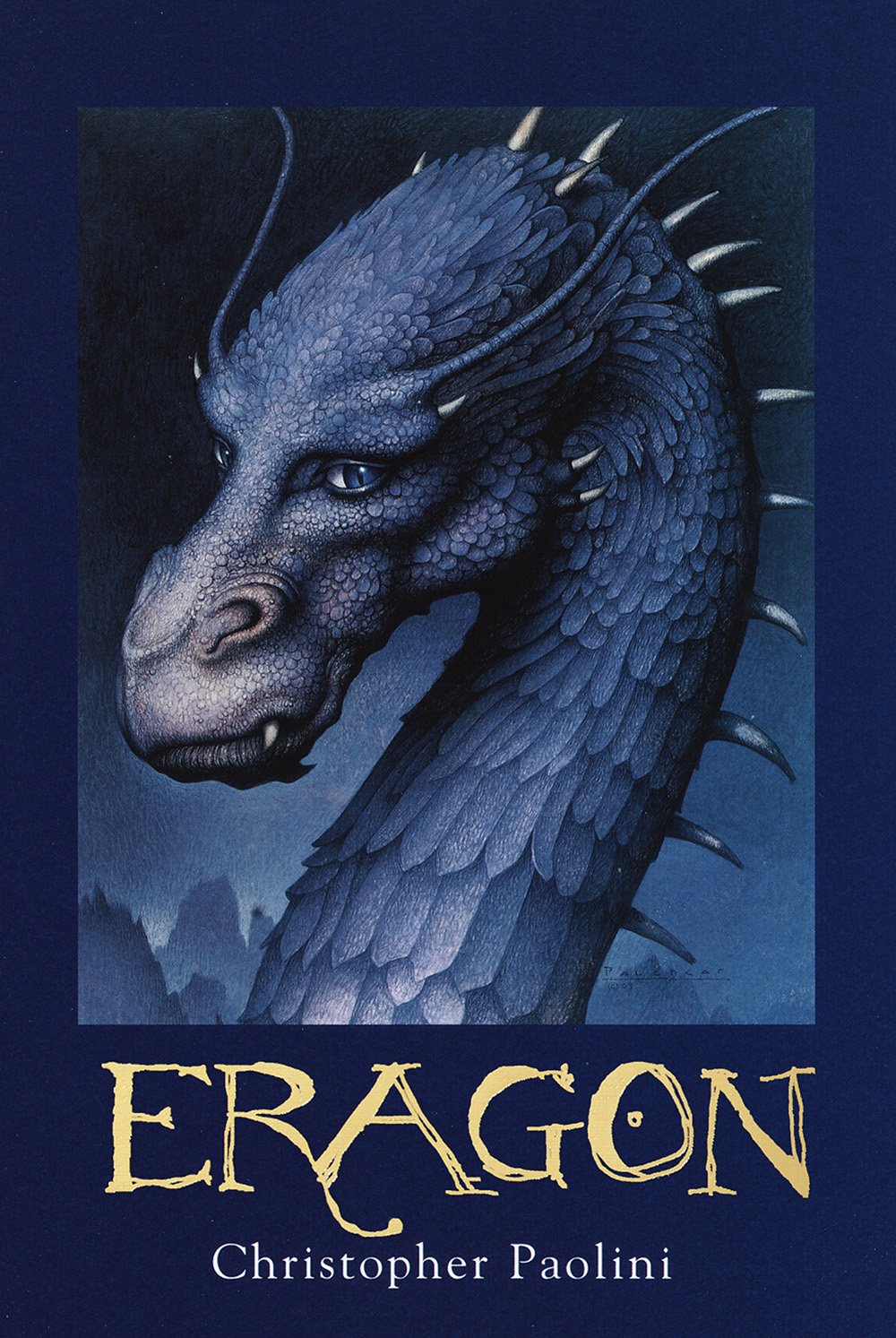
This was a favorite book of mine when I was in middle school and high school (am I dating myself?). I always loved dragons when I was a kid, and so I ate up any book, TV show, movie, or any other media that had anything to do with a dragon. Maybe that explains why I like the 2000 Dungeons & Dragons movie so much (absolute cinema, perfection, no notes). I was also super into protagonists who were loners, edgelords, and shadows. My Runescape username was DrakeLord95, so now you know exactly who I was back in middle school.
While Eragon, the main character, is not exactly an edgelord, they are definitely a loner with a dragon. And I was so into that. I read every book in the series multiple times. I played the video game (which was pretty good), and I’ve watched the movie… three times. Once in the theater, once on DVD, and once on DVD with director commentary. Needless to say, I was into Eragon when I was a kid.
As an adult… well, not much has changed. My username on Reddit is VaranSL, which is the name of a character from a book I was writing (in middle school). What does the SL stand for? Shadow Lord.
Yup, I’m still trying to be an edgelord.
All this to say, I’ve been reading Eragon for a long time now, and I still enjoy it, so let me just go ahead and get into the review.
Review
4.75/5
I sure hope you aren’t shocked that I rated this book so highly. It was incredibly influential for me growing up. It was my Lord of the Rings or Star Wars or whatever media you had growing up (if you are from the future, I guess like… Skibidi Toilets and Mr Beast?).
The first book, and I’m only reviewing the first book, is written competently if a bit at a junior level. Which is no surprise since the author was 14 when he wrote the first draft. The books improve in terms of writing throughout the series and in his later books.
My favorite parts of this book are the dragon and rider bond, and the magic. I think the bond is great, it shows depth and character growth for Eragon, and lets us get into his head through someone who loves him deeply (Saphira, his dragon). The magic is also great, not just the language created for it, but how the author describes how magic drains the caster, and how the author uses those prominent effects throughout the book. You don’t ever feel like magic is safe at all, and the author continues to treat it like a very dangerous system over the course of the adventure.
There is one main criticism I hear about Eragon. That it is a rip-off of Star Wars: A New Hope, which is just dumb. Is it a rip-off? No. Is it inspired? Definitely. Does that make it bad? Not in the least.
Eragon wears its inspiration more prominently than a lot of media, but that doesn’t make it bad. People love pieces of media and are inspired by, taught, and influenced by media they adore. Eragon is an example of a story having a very prominent inspiration and being good. For an example of taking inspiration and being bad, look at Star Wars: The Last Jedi, which is a direct rip-off of Star Wars: The Empire Strikes Back, but in reverse and worse.
Goes On The List?
Should Eragon go on Dump Stat’s brand-spanking-new Appendix N list?
Definitely.
It doesn’t break a lot of new ground, but it is very approachable, has some cool ideas in there, and is a thoroughly good fantasy book.
With this being the first book being reviewed, I should probably also add… I’m probably going to add most things I review to this list. Even if I don’t enjoy it, I’m sure I’ll find things to enjoy within it. That said, don’t just assume that if I enjoy something, I think it should be added to the list. I like The Muppets, doesn’t mean I think The Muppet TV show should show up in our Appendix N list (Muppet Treasure Island, however…).
Eragon
The book begins with three elves being attacked by the book’s orcs (known as Urgals) and Durza, a shade who is one of my favorite monster ideas. Just a collection of spirits wrapped in a mortal’s body, granting great power and ripping out the original soul, created by those who seek revenge no matter the cost. Two of the three elves escape, the last one is captured, but before she is captured, she teleports a dragon egg and safeguards it from the shade.
We cut to Eragon hunting in the woods, trying to hunt a deer, before the dragon egg appears and scares off the deer. Eragon has no idea what the egg is; it looks like a big sapphire, and he leaves the mountain range he is in and heads back to town, hoping to trade it in for food. After a few days, the dragon egg hatches and Eragon raises the dragon in secret.
As the dragon is growing up, Eragon encounters Brom, a storyteller in town who knows an awful lot about dragons. Soon after, two of the evil king’s servants, known as the Ra’zac, come to town and are searching for the dragon egg. Eragon and Saphira, the dragon, hide, and Eragon’s uncle is killed. Eragon wants revenge against the Ra’zac and decides to chase after them, with Brom tagging along to help Eragon.
During their travels, they are attacked by urgals, learn more about the Ra’zac, and Eragon is taught how to swordfight and use magic by Brom. Eventually, the two travel to the home city of the Ra’zac where Brom is killed in an ambush, and Eragon is saved by a mysterious fighter, Murtagh. Eragon and Murtagh decide to learn more about a group of rebels, known as the Varden, who they think will help them defeat the Ra’zac and avenge Brom’s death.
They travel to another city, Eragon and Murtagh quickly becoming fast friends, and they learn that the elf from the beginning of the book is being held prisoner. They plan to break her out, but they are ambushed by the king’s men and urgals (who are working for the king), and Eragon is taken hostage while Saphira and Murtagh are able to escape.
Eragon awakens in prison, drugged, but through force of will is able to break out, the same time that Murtagh is fighting to break Eragon out. They find the elf being held prisoner, though she is in a coma, and they spirit her away from the jail, outrunning the king’s men and the urgals. They then must travel hundreds of leagues across a desert to find the Varden.
During this travel, they stumble across an urgal army who gives chase. They soon find the Varden, who are housed by dwarves, and are taken as prisoners by them, as the Varden are suspicious of these new arrivals. Eragon, Saphira, and Murtagh must prove their trustworthiness, and it is revealed that Murtagh is the son of an ancient dragon rider who had helped the king destroy the dragon riders of old who once ruled this land.
The elf, Arya, wakes up, and it’s pretty obvious that she will be the love interest in future books, especially as Eragon is so gobsmacked that it is… a little cringe. Eventually, the Varden and dwarves are attacked by a huge army of urgals, and Eragon, Murtagh, Arya, and Saphira must defeat the army. During this attack, the shade Durza arrives, and Eragon must fight him, and just as it looks like Eragon will lose, Saphira arrives, breathing fire on the shade for the first time, and saves the day.
The Good
This book doesn’t have the most original story, but that’s OK. What it does have is an entertaining and gripping read. The book is quick, it tells the story it wants to tell, and it is great for when you want a book where good wins over evil.
What is also has is interesting monsters, the urgals are very orc-like, and while they are generic fantasy in this first book, they do go on to have a more interesting society and culture in future books. In addition, the magic descriptions are great and I’ve more than once stolen a few words of magic for my descriptions in games. In addition, I love Durza the shade. He is very interesting to me and I’m just sad he died in this book instead of remaining a presence in all the books.
The Bad
As much as I like this book, it has some technical problems in it. The dialogue can be awkward and cringe (I know, using cringe in a review is bad writing.). It has some story beat problems, like it takes three-fourths of the book for Brom to die (which feels more like something that should happen in the very middle of the book), but then a huge amount of stuff happens in the last 50 pages of the book that feels rushed.
In addition, the description of the dwarven city, Tronjheim, has always confused me, and it feels like characters teleport around this massive, hollowed-out mountain that should take them a day or more to travel. I think a bit more time in the last section of the book could have really elevated it, as it feels rushed and not as thoughtfully written as the rest of the book.
Takeaways
Magic, dragons, and high fantasy. This book is great at showing you how you could take stories you love and turn them around for use in a Dungeons & Dragons adventure. I think the best adventures lean on famous media, giving the players something to immediately grok and play against. Who isn’t excited when they trigger a big rolling stone trap and imagine their character outrunning it like Indiana Jones?
I also, as I mentioned above, have stolen a few magic words and worked them into descriptions of rituals and spellcraft in my home campaigns. It’s great to have a ready resource that sounds very magic-like that you can lean on. Speaking of magic, I also appreciate how magic is used and the description of how it drains the body and how much of a threat it is to those who use it unwisely. Incredible to think about, especially if you want to have a variant rule where characters can sacrifice their hit points or take exhaustion levels if they want to cast strong magic but are out of spell slots.
Other Media
If you liked this book, I’d recommend finishing the series. The longer it goes on, the more unique the story goes. It never fully deviates from The Heroes Journey (which is just the basic building blocks of storycrafting), but dragons, urgals, and more are all fleshed out.
In addition, check out these books:
Dragonflight (1968) by Anne McCaffrey (This might be the one book I break my ‘no old books’ rule on. I have no idea how it never ended up on Gary’s list, and, frankly, I think a lot less of his suggestions even more because of its absence.)
The Hobbit (1937) by J.R.R. Tolkien
Dominion of Blades (2017) by Matt Dinniman
Like what we do?
Join our Patreon!
You’ll get early access to deep dives, the Homebrew Hoard
featuring 500+ monsters, ad-free articles, and more!
Follow us on Reddit to keep up to date on everything we talk about!