
The Blue Star - Reviewing Appendix N
Alright, so this book report is about two years late, but I refuse to take any responsibility for that. I blame the book. Also, if you’re memory is better than mine, you’ll recall in our last article in the Reviewing Appendix N series with Jack of Shadows (good book with a great setting, go read it), that I was going to read The Shadow People by Margaret St. Claire.
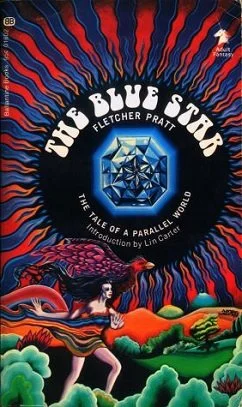
Well, The Blue Star (1969) by Fletcher Pratt is not that book. I didn’t want to drop over $50 for an old book that I may not like that much, and I couldn’t find an ebook version of it. So if you’re Margaret St. Claire’s people, get it republished or available as an ebook, and I’ll review it and say lots of nice things about it (that’s not a promise).
So anyway, I wanted to read something appropriate for Halloween two years ago, and I saw no reason to change that. So I ended up going with The Blue Star, not because I thought it might be horrific, but because it was less than a dollar on Kindle, and the brief description seemed interesting, and it had to do with witches, and, based on my repeat viewings of the incredible 1993 film Hocus Pocus, witches have to do with Halloween.
Boy, was I wrong on that one (not the cost amount or that Hocus Pocus is an incredible film).
What’s Next
Of course, we can’t jump into The Blue Star without sharing our next book to read, and this time it won’t take me two years to do a review on it (hopefully).
BUT, we’re going to do something a little different. Instead of talking about books in the Appendix N of some old, dusty book that hasn’t been updated in forty years, we’re going to talk about books I think should be included in a revamped Appendix N. This first book isn’t the most important book I think should be in an Appendix N, but it is one that I think a lot of people have read and probably a good chunk of people like… even if they haven’t read it in a long time.
Our next book will be Eragon (2002) by Christopher Paolini! I haven’t read this book in over a decade, so I’m excited to re-read it. If you have suggestions as to what should be in a new Appendix N, drop them in the comments below!
Now, let’s end the celebrating and get on with the main star (did you see what I did there?) of the show!
The Blue Star by Fletcher Pratt
I’ve never heard of this book or author before this project, and I’ll be honest, this project has been a bit of a mixed bag. Appendix N reads less like “these books are the pillars of D&D fantasy” and more like “Gygax’s random assortment of books he was looking at when he wrote the Appendix N.”
That said, The Blue Star is definitely fantasy, and definitely fits into Dungeons & Dragons because it is about an alternate world where, instead of developing gunpowder, humanity develops witchcraft and alchemy (which the first chapter is just about people talking about what a world like that would be). So it’s great if you want to dive into a world where guns were never introduced; however, it has some problems.
Some serious problems. And I’m not just talking about all the sexual assault.
Review
At this point, I provide my score, and I want to say that in the first few chapters, I thought it was going to be a lot higher, but once I hit about 10% into the book, that score tumbled like a dead dragon in the air. We’ll get into the specifics, but I’ll just say, if sexual assault is a trigger for you, I’d jump to a happier book review, like Jack of Shadows or The Hobbit. Those are great books, you should read them.
1/5
Nope. I don’t feel a need to re-read this book. I barely wanted to continue reading this book. And this isn’t a ‘hurr-durr sex bad’ reaction.
The main character gets raped within the first few chapters, and then we’re supposed to just go along with it and act like her rapist is a fine, if flawed, character. Not only that, but she grows to love them and runs away with them multiple times, and forgives him constantly for being a terrible partner.
If this book isn’t a classic example of a shitty man being rewarded with a woman for simply having a pulse, I don’t know what would be.
The Blue Star
This book opens up with three people talking about what the world would be like if it didn’t have gunpowder, and instead placed its efforts on developing witchcraft the same way our world developed gunpowder. It is a great idea for a book, and I couldn’t wait to see what happens.
The book then truly opens up with our main character (Lalette) talking to her mother and discussing all the troubles they are dealing with. We then get introduced to our other main character (Rodvard), who has joined a revolutionary group (Sons of the New Day), and they want Rodvard to seduce Lalette, become her lover, and gain access to her blue star.
Witchcraft exists in a very limited way. Only women can be witches, and only a few witch bloodlines exist. What makes witchcraft even rarer is that only one person in the family can be a witch, and this power is passed from mother to daughter at the daughter’s loss of virginity. In addition, the blue star (a rare jewel) will only work for the witch’s lover and can use the amulet to read the mind of anyone the lover sees the eyes of. This amulet retains its power until the lover is unfaithful or, I assume, the witch has a daughter who decides to sneak off and sleep with some dude.
This gets us to a jump forward in the story where the two characters, who hadn’t met each other before, have now been seeing each other for over a month. At this point, Rodvard rapes Lalette after she tells him no and tries to run away. Lalette had even told him before the incident that she didn’t want to ever have sex because she didn’t want to become a witch. Now she is a witch.
She goes home afterwards and ends up having dinner with a Count Cleudi whom her mother is trying to get her to marry, and she ends up witching him and telling him to leave her alone. Turns out, witchcraft is basically outlawed in this kingdom (defeating my entire excitement over how the author would develop this world like gunpowder has developed ours), and she has to go on the run. She first runs to Rodvard seeking help, and while he helps, he sure makes sure that she understands it’s her fault and she shouldn’t have dragged him into this situation.
They hide out for a time, they have sex again, though Lalette is unwilling, and Rodvard even states that she isn’t willing, but he still forces her into it. So, Lalette gets raped again, but at this point, Lalette starts wondering if she actually does love Rodvard. Rodvard, from his point of view, doesn’t like Lalette much at all and keeps thinking about every other woman. In fact, throughout the book, all Rodvard does is think about how he would have a better life with other women he meets.
At this point, the two split up. Rodvard has to help with his secret revolutionary group and is learning to use the blue star, while Lalette is basically stuck in her hideout, unable to leave for fear of being found by the city guard. While split apart, Rodvard is part of some secret machinations, has sex with someone other than Lalette (which makes his blue star falter), and then has to go on the run from the guards for a reason that I was unable to understand in the book as there are so many time jumps and information skipped over that it was incredibly hard to understand what was going on.
Rodvard runs from the city and, while running away, gets a ride with a seemingly kind farmer who takes him to his home. There, the farmer’s wife turns out to be a witch, and Rodvard is almost killed and all his stuff stolen; however, the witch recognizes he has a blue star, and she fears that the witch who gave Rodvard the blue star will seek her out and kill her. Instead, it is implied that the witch rapes Rodvard, recharging his blue star so it can work again.
I’m now going to skip a lot of stuff, but basically, Rodvard and Lalette both make their own separate ways to a new kingdom run by a religious group who believe that anything material is basically put here by the God of Evil and that their deacons needs to have sex with women to push out the evilness in their body (whether the woman really wants to or not). They find each other in this new land, and Rodvard kind of kidnaps Lalette, but she isn’t happy being forced to become a sex-nun.
They attempt to flee the religious kingdom, but get caught and brought to prison. They are soon saved by a person who is part of the revolution that we have never met. Rodvard and Lalette return to their original city, where the revolution is in full swing. Rodvard, using the blue star, finds some spies, and while he loves the revolution, Lalette is unhappy. The book ends with the two running off together and Rodvard tossing the blue star into a river.
The book really ends with the original three from the start of the book, who came up with the concept, breaking the fourth wall and pondering about their created world, which one of them included all the sex, and then asking if their world was even real.
The Good
Uuuuuh. The initial concept that sold me on reading this book was really good. The idea that a civilization didn’t have gunpowder or science, but instead had witchcraft and alchemy, was really interesting, and I’d love to see someone else’s spin on that.
Unfortunately, that doesn’t happen in this story. There would’ve been no difference to the story had gunpowder been in there with the very little amount of witchcraft (and basically no alchemy). So, I guess I don’t really have anything in the “Good” section.
The Bad
It should be pretty obvious what the “Bad” in this is. I’ve read plenty of books where the main character (or one of them), is a bastard. Where they’ve sexually assaulted people, where they have very few redeeming qualities, but the author knew that and didn’t try to make it seem like what they were doing was fine or not that big of a deal.
But apart from that, the book has plenty of other flaws. The political situation in the book is briefly talked about, but you never get a clear understanding of what’s going on, why you should care, and, even worse, when the big moment happens… the characters aren’t even part of that story. They just learn about it after it was done and they get to help ‘rebuild’ their kingdom.
On top of that, there are so many timeskips, you have no idea what’s going on. With those timeskips, the characters meet new people, they get into new situations, and then you only find out about those situations as a passing sentence. Perhaps, since this book was part of a three-book omnibus when first published, things had to get cut, but it’s a mess.
The biggest problem I have with this book is that it takes its really cool premise and then makes witchcraft and alchemy illegal and only two characters can use witchcraft. It really feels like it didn’t use its idea at all, like Fletcher Pratt wanted to tell a pseudo-historical political thriller, and decided to include a single witch in it for fun (who does very little).
Takeaways
I got nothing. I was hoping for some cool things to add to my world I hadn’t thought of when witchcraft and alchemy are treated as science, but sadly that concept isn’t really taken anywhere.
Other Media
If you want some literature that I think is sort of like this, but better, here are my suggestions:
Prince of Thorns (Broken Empire, #1) by Mark Lawrence
The Black Prism (Lightbringer, #1) by Brent Weeks
Promise of Blood (Powder Mage, #1) by Brian McClellan
Like what we do?
Join our Patreon!
You’ll get early access to deep dives, the Homebrew Hoard
featuring 500+ monsters, ad-free articles, and more!
Follow us on Reddit to keep up to date on everything we talk about!